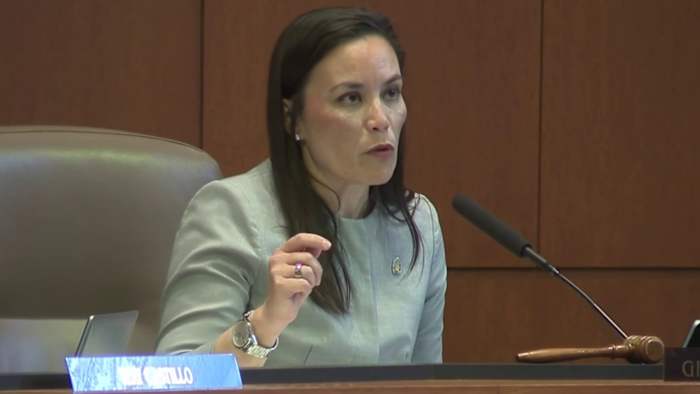
San Antonio Mayor Gina Ortiz Jones wrote to Homeland Security Secretary Markwayne Mullin asking federal immigration officers to avoid actions that could frighten lawful voters, after a traffic stop by the Texas Department of Public Safety led to ICE joining other agencies outside a West Side library in Bexar County. The stop resulted in the arrest of 50-year-old Rogelio Cortez on a vehicle burglary warrant, and county officials say voting was not disrupted. Sheriff Javier Salazar told a trooper to “get out of here because it’s intimidating the voters,” then later called the trooper “extremely professional” and stressed the Bexar County Sheriff’s Office handles “election security.” Mayor Jones asked for guidance on sensitivities around polling sites and offered an “open dialogue” with Secretary Mullin.
City officials are warning about the optics when immigration enforcement shows up near places where people cast ballots, and that warning landed in a formal letter. Jones’ request centers on avoiding any appearance that enforcement activity might dissuade lawful U.S. voters from showing up, an explicit line she wrote to Secretary Mullin asking federal officers to “take steps to not inadvertently deter or dissuade lawful U.S. voters from voting due to fear,”. That sentence is the core of her appeal: protect public safety but protect participation in the democratic process at the same time.
The incident began as a DPS traffic stop and escalated when multiple agencies converged outside the library. Rogelio Cortez, 50, was arrested after troopers said he had an outstanding vehicle burglary warrant. Bexar County officials made a point of telling residents that the arrestee was not a voter and that the event did not “affect access to the polling site or disrupt voting operations.” Those statements are meant to calm voters, but the presence of federal agents still raised alarms for local leaders.
Sheriff Javier Salazar’s reaction added a tense, public layer to the story when a witness recounted him telling a state trooper to “get out of here because it’s intimidating the voters.” Salazar then issued a statement calling the same trooper “extremely professional” and making it clear his office is responsible for “election security.” That back-and-forth shows how law enforcement agencies can have different priorities in the heat of an election and why Mayor Jones pushed for clearer guidance from Washington.
From a Republican perspective, the balance here looks straightforward: law enforcement must be free to do its job, but officials should also avoid actions that could be mistaken for voter intimidation. Local leaders have a duty to protect polling places, and federal agents have a duty to enforce immigration and criminal laws. When those duties collide near a polling site, the political fallout can be immediate, which is exactly why Jones asked for sensitivity and clarity from federal leadership.
The mayor didn’t stop at a public note of concern; she formally asked for policy guidance about operations near polling locations. She wants federal officials to recognize the unique sensitivities around election sites and to make sure enforcement activity does not block or scare away people exercising their right to vote. At the same time, county officials emphasized that voting continued and the arrest was unrelated to anyone casting ballots, a point intended to reassure voters.
This episode in San Antonio illustrates a broader challenge for cities and counties across Texas when federal and state agencies operate in close proximity during elections. Even if an arrest is lawful and unrelated to voting, the sight of multiple uniforms and squad cars can be intimidating, especially in communities with large immigrant populations. That’s why Jones offered an “open dialogue” with Secretary Mullin — she’s pushing for communication and protocols that prevent confusion and preserve turnout.
For residents watching this play out, two facts stand out. First, Bexar County officials say the polling site was not blocked and voting operations carried on. Second, local leaders want clearer rules so officers on the ground know how to act around election sites. Both points are meant to calm nerves, but they also underscore the political reality: enforcement actions near polling places will be examined closely by voters and officials alike.
Below is the full letter from Mayor Jones to the Department of Homeland Security, included here so readers can review the request and the phrasing that drew attention.