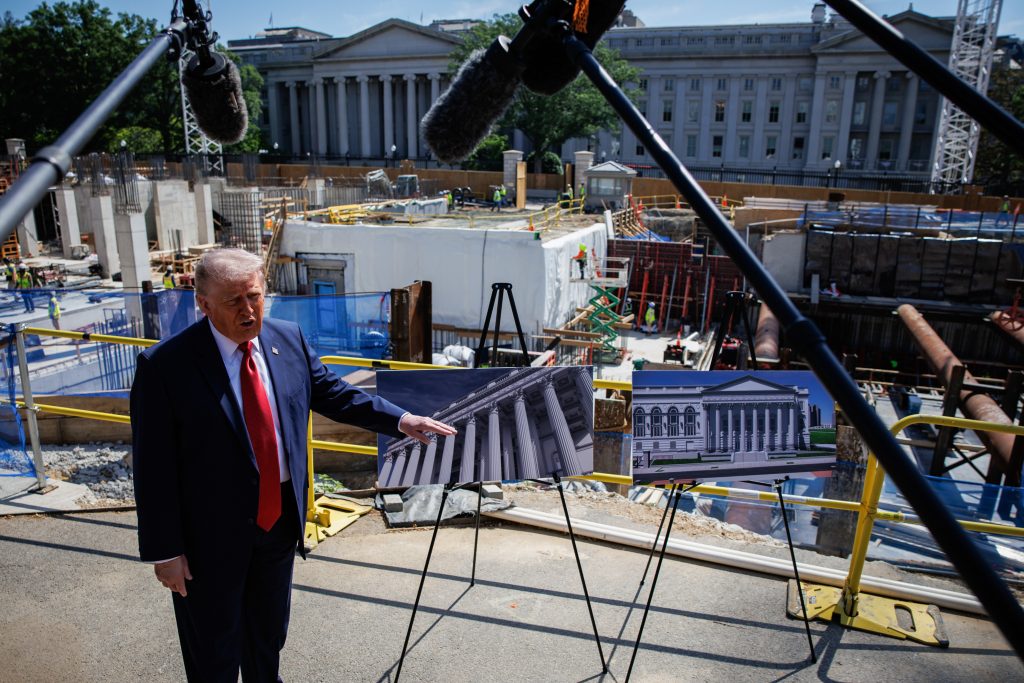
President Donald Trump took reporters up to the White House construction site to show off the new ballroom project on the former East Wing footprint in Washington, D.C., touting security features and donor funding while defending a $1 billion request for broader campus upgrades. He spoke about drone protection, underground levels, and how the space will serve future presidents, and White House spokesperson Davis Ingle framed the tour as transparency. The project has drawn lawsuits from the National Trust for Historic Preservation and The Cultural Landscape Foundation, and polling from the Washington Post/ABC News/Ipsos shows widespread public opposition.
Trump cut through the construction noise to make his case in person, turning the hard-hat bustle into a backdrop for a sales pitch. He held renderings and quipped, “Give that to me, I’ll hold it,” while emphasizing the scope of what’s being built. The president insisted the complex is built with security first in mind and painted the ballroom as a long-term asset for the presidency.
He repeatedly highlighted the roof’s toughness, calling it “dead flat” and made of “very strong steel,” and argued it is “drone-proof.” Trump added color to the explanation with graphic language about resilience, saying, “if a drone hits it, it bounces off, it won’t have any impact — but it’s also meant as a drone port, so it protects all of Washington, the roof of the building.” That pitch points to a core Republican talking point: national security has to come first.
The president also described the roof and the below-ground levels as a single, integrated system, noting that the project goes down six stories and that “everything is intertwined.” “The roof goes with the ground floor, the ground floor goes with the roof. The roof also goes down into the basement,” he said, stressing the building’s complexity. That technical framing serves to justify the unusual cost and scale.
Trump said the ballroom space will support a military hospital, research facilities, offices for the first lady and staff, a full kitchen, and an event hall large enough for 1,000 guests. He framed the ballroom as a protective “shield” for the campus and as infrastructure that helps protect Washington. The idea is to set the construction as both practical and prestigious.
On the money question, Trump insisted the $400 million cost for the ballroom itself will come from donors and from him, insisting, “This is not going to be paid for by the taxpayer.” He called the project “a gift to the United States of America,” positioning it as a philanthropic contribution rather than a budgetary burden. That claim, though, hasn’t quieted critics who worry about the broader $1 billion security request tied to the project.
Congressional maneuvers have already complicated the effort. The Senate parliamentarian ruled the funding push couldn’t ride inside a bill to finance immigrant enforcement agencies for three years, and some Republican lawmakers say they balk at the price during an election year of tight wallets and inflation concerns. That split leaves the administration pitching directly to the public while negotiating in private.
Public opinion hasn’t been kind: a Washington Post/ABC News/Ipsos poll in April found 56% of U.S. adults oppose tearing down the East Wing to build the ballroom, with only 28% in favor. Preservation groups took action in court, with the National Trust for Historic Preservation suing to halt construction until Congress signs off on plans. Legal challenges add a new layer of uncertainty to a project Trump says is meant to outlast him.
Trump told reporters the ballroom will be ready in September 2028, a timeline that makes it useful mostly to future presidents, and said flatly, “This is really for other presidents.” He also declined to say whether he’d personally put up more funds if Congress refuses the broader $1 billion package. That stance leaves open the possibility of a private-public patchwork if lawmakers won’t cooperate.
White House spokesperson Davis Ingle framed the visit as a transparency move, saying the president “was excited to showcase to the press and American people the amazing gift he is giving to the White House and generations of future presidents to come.” The message is straightforward: this is an investment in the institution, and the White House wants the public to see it. The administration is leaning on optics as much as on technical explanations.
Beyond the ballroom, Trump also talked up other city projects he’s pushing, including restarting dormant park fountains and work on the Lincoln Memorial Reflecting Pool. He claimed to be spending less than his predecessors to restore the pool, saying, “I’m doing a job on the Reflecting Lake for a fraction of what they paid.” That effort, like the ballroom, has attracted legal pushback from The Cultural Landscape Foundation, which sued to halt the reflecting pool work.
The media tour was part show-and-tell and part defense, aimed at shaping how Americans see a costly, controversial build on the White House grounds. Trump emphasized security, future use, donor funding, and visible action around the capital as reasons to accept the plan. Opponents point to public opposition and preservation fights, and the legal and political battles are likely to continue as construction moves forward.