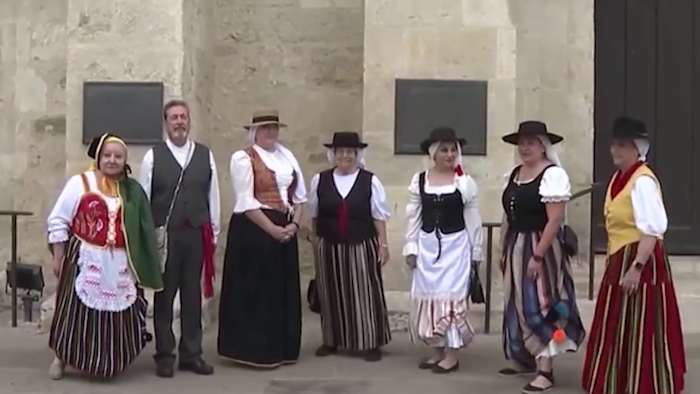
San Antonio is marking a milestone this year as America turns 250, and descendants of the Canary Islanders — including Julia Lopez, Sharon Pelayo Simonick and Anthony Delgado — are reminding the city and the nation that their families arrived centuries earlier and helped forge the first civilian government in Texas. Their story reaches back to 1731, when 16 families landed after a grueling Atlantic crossing and a trek through Mexico, and it still lives in places like San Fernando Cathedral and in the devotion to Our Lady of Candelaria.
The tale begins with an ocean voyage ordered by the King of Spain and a march inland that few modern residents truly picture. Canary Islanders were sent to settle the New World in 1730 and landed in San Antonio on March 9, 1731, stepping off a ship into a landscape that would become their new home. It was a dangerous, uncertain choice, but one that planted roots and a civic structure that outlasted empires and borders.
Descendants have long insisted their ancestors were more than settlers; they were architects of local governance. While Spanish missionaries were in the region earlier, the Canary Islanders helped organize the first civilian government in Texas, and families from that group took civic roles that shaped the early life of the town. Those civic ties remain a point of pride for community members who trace their lineage back to that 1731 arrival.
“It’s important for us to know who we came from,” said Julia Lopez, president of the Canary Islands Descendants Association. “That’s how we know what tomorrow brings.” Her words underline how family memory and institutional history combine to give a modern community a sense of direction, not just nostalgia. For many in San Antonio, that continuity defines how they see themselves in the larger American story.
Some descendants put their familial role in blunt terms when talking about early leadership in the city. “Our families were the first mayors of San Antonio,” Sharon Pelayo Simonick. “Our families were the first council people, our families were the first sheriff.” Those declarations are repeated at gatherings and ceremonies as proof that ordinary families carried extraordinary responsibility in the settlement and governance of an emerging town.
The Canary Islanders also left a spiritual mark on the city that is visible inside San Fernando Cathedral. Their devotion to Our Lady of Candelaria, the patroness of the Canary Islands, continues to be honored there, a living bridge from Tenerife and Gran Canaria to downtown San Antonio. Religious devotion helped bind communities together and offered a shared identity that lasted through changing national tides.
For many descendants, the story of migration and settlement reads like a condensed American epic: resilience, sacrifice and the search for a better life. “I think our story is so important because we are the story of America,” Lopez said. “We’re the story of immigration, we are the story of people who came to find a better life.” Those words connect local memory to the larger themes that Americans observe during this 250th year.
Learning family history also reshaped how some descendants view national events, tying personal lineage to broader milestones. “Learning about our ancestors’ contributions to the American Revolution makes that history more personal,” Anthony Delgado said. “I now have an ancestral investment in this thing called America and its revolution and independence.” That sense of ownership changes how people celebrate, mourn and teach history.
Celebrations this year have a double meaning: they honor a nation’s 250-year arc and also spotlight a local story that predates the republic but feeds into its ideals. For descendants in San Antonio, the Canary Islanders are not a footnote but a founding chapter that informs civic life, faith and family identity. Their presence helps cities remember how layered and complex American origins really are.
Across gatherings, processions and quiet visits to the cathedral, the Canary Islanders’ legacy is both visible and spoken. It shows up in civic ceremonies, in family reunions and in the way local leaders and historians point to those 16 families as starting points for a community that would grow into one of Texas’s largest cities. The past is not distant for these families; it’s woven into their present.