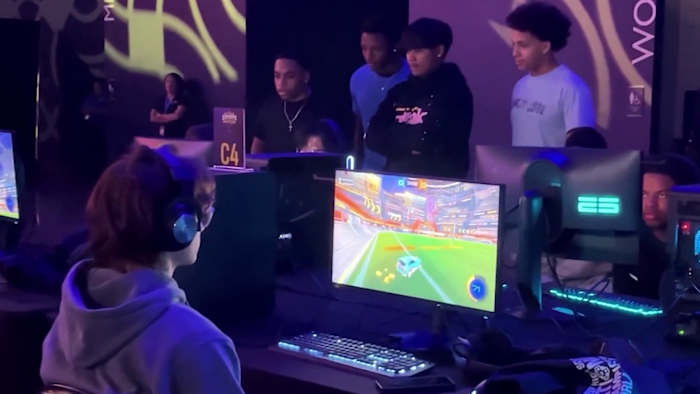
The Boeing Center at Tech Port in San Antonio is hosting the Forge Scholastic eSports Championship, a weekend-long event produced by the San Antonio Museum of Science and Technology and the R-20 Premier eSports League that draws hundreds of student competitors and spotlights how gaming skills can lead to real careers. Organizers including Josh Martinez point to rapid growth across local high schools and independent school districts, while students such as Alexander Raimondi say the experience builds teamwork and performance under pressure. The tournament runs Friday through Sunday with free public admission and is positioned as a hands-on gateway to postsecondary study and high-demand jobs.
San Antonio-area students from dozens of high schools are converging on the Boeing Center at Tech Port to compete, learn and network over a packed weekend schedule. The Forge Scholastic eSports Championship opened Friday morning and continues through Sunday evening, with public admission offered free, giving families a low-barrier way to see what scholastic eSports looks like in practice. Event organizers have turned a once-small local competition into a multi-school showcase that mixes intense matches with opportunities to explore career pathways tied to gaming and technology.
Growth has been dramatic, and organizers are blunt about what that means for students and the local talent pipeline. Josh Martinez, director of esports at SAMSAT and R-20 Premier League organizer, said the high interest speaks for itself. “In year one, we had 80 students in our grand final. Now, we serve about 650 students from 35 high schools and 17 ISDs,” Martinez said. “Our monthly average is about 300 competitors per month, so it’s grown significantly and it shows no sign of slowing down.”
That expansion has changed how parents and educators view gaming, turning a hobby into a potential stepping stone toward careers in engineering, media, software and systems operations. Tournament play demands split-second decision-making, clear communication and strategic thinking, and organizers are framing those traits as marketable skills. For many students, the championships are the first place they see their pastime mapped to a possible profession rather than dismissed as mere screen time.
Participants describe the experience as more than clicking and aiming; they call it a crash course in teamwork and pressure management. “I got to go in there and learn what it means to be in like a high-stress team, right? Where, like, everything matters,” Raimondi said. “You have to communicate effectively. Your personal performance is as important as your team cooperation.” Those lessons translate to group projects, lab environments and any workplace that relies on rapid, coordinated action.
Raimondi, who plans to study electrical engineering at the University of Houston this fall, sees esports as part of a broader educational arc rather than an end in itself. He wants families to recognize the constructive side of gaming and to support kids who show early interest. “They’re not just trying to waste time,” Raimondi said. “So, like, especially the younger kids, if they’re first getting into something, like, nurture that.”
The conversation around gaming skills has moved beyond local gymnasiums and school auditoriums to national agencies and employers looking for talent. The Federal Aviation Administration has publicly noted a shortage of qualified air traffic controllers and is recruiting candidates with spatial reasoning, fast decision-making and calm under pressure — abilities that competitive gamers routinely exercise. Organizers and career counselors are using those examples to broaden parents’ and students’ thinking about where esports experience might lead.
Event planners hope the Forge Championship will act as a recruitment and education showcase where students can meet coaches, mentors and industry folks who see gaming as a pipeline to STEM fields, broadcasting, software development and operations roles. The San Antonio Museum of Science and Technology emphasizes that the R-20 Premier League is as much about skill development as it is about competition, pairing tournament play with conversations about scholarships, degrees and career paths. Families attending the free weekend event can watch matches, talk to program leaders and see firsthand how structured gaming programs operate across dozens of local schools.