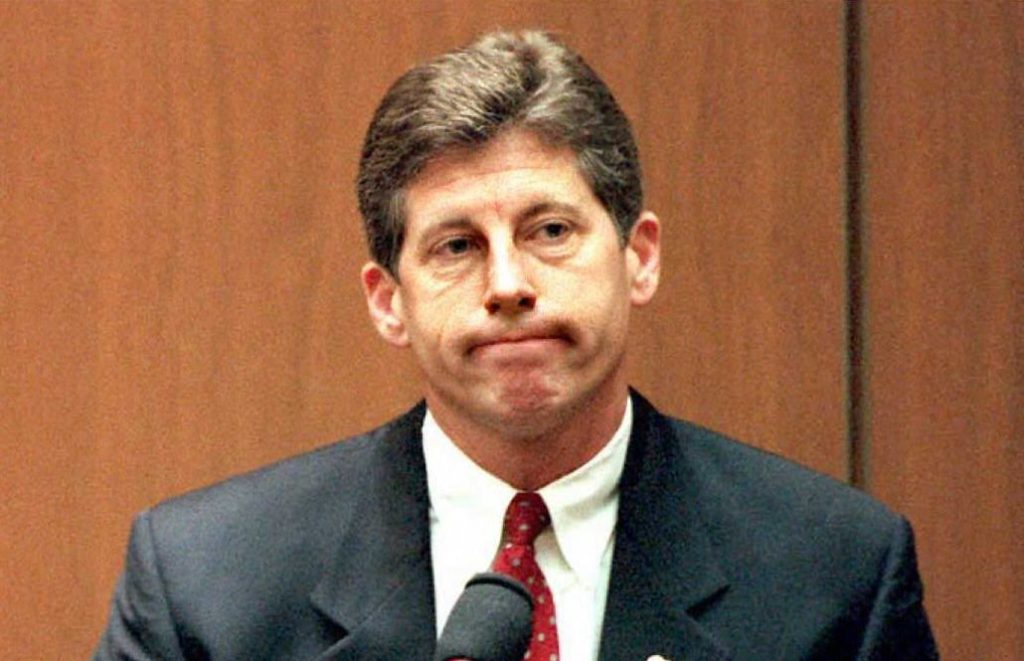
Former Los Angeles Police Department detective Mark Fuhrman, known nationwide for his role in the 1995 O.J. Simpson murder trial, has died at age 74 in Los Angeles. Fuhrman’s testimony and the later revelation of tapes that captured racist language made him a focal point of that case and of debates about law enforcement and race. His death closes a chapter on a figure who remained in the public eye for decades after the trial.
Fuhrman rose through the ranks of the LAPD as a homicide detective and was called to testify during the Simpson case after investigators tied several pieces of physical evidence to the crime scene. His identification of certain items and accounts of the investigation became central to the prosecution’s narrative. For many Americans, those courtroom moments are what define his public legacy.
But Fuhrman’s reputation never recovered from the controversy that followed. Tapes surfaced in which he used racist language, and questions were raised about the accuracy of his testimony and his conduct as an investigator. That controversy shifted public focus from the evidence itself to the credibility of witnesses and the broader dynamics between police and the communities they serve.
The Simpson trial was already a media spectacle when Fuhrman’s role turned into a flashpoint. The case exposed fault lines in how the criminal justice system, race, and media interact, and Fuhrman’s name became shorthand for those clashes. In courtroom transcripts and news cycles, his testimony was replayed and scrutinized over and over.
After the trial, Fuhrman left the LAPD and pursued opportunities in writing and media that kept him visible. He authored books on crime and investigative technique and appeared in interviews defending his record and explaining his perspective. Those projects let him tell his version of events to a public that had already made up its mind about much of what had happened.
Supporters praised Fuhrman for his investigative work and for speaking openly about law enforcement challenges, while critics pointed to the tapes and to what they saw as a pattern of behavior that undermined trust. That split reflects how polarizing moments in criminal cases can create lasting, opposing narratives that are hard to reconcile. Whether remembered for investigative skill or for controversy, his presence in the Simpson story remains undeniable.
Legal observers say the episode highlighted how a single witness can alter the course of a trial and public perception. Fuhrman’s testimony, the ensuing debate about evidence handling, and the questions about bias prompted broader conversations about standards for police testimony and discovery in high-profile cases. Those discussions have echoed in reforms and procedural debates in courtrooms across the country.
Community leaders and commentators have used the case as a reference point in conversations about policing and accountability, often citing the episode when arguing for changes in training and oversight. For many residents of Los Angeles, the trial reopened wounds tied to a longer history of mistrust between certain neighborhoods and law enforcement. The city’s reputation and relationship with its police department were part of the national story spinning out of that courtroom.
Fuhrman’s presence in popular culture lasted far beyond the trial itself, with documentaries, books, and news specials revisiting his role repeatedly. That continued attention turned his life into a kind of public case study about how individuals who work in the justice system are judged in the court of public opinion. His name became a reference point for journalists and producers exploring the Simpson case and its aftermath.
Friends and colleagues who worked with him in Los Angeles remember a detective who believed in thorough police work and who defended his actions in public forums. Others remain critical, arguing that episodes like the tapes should have carried greater consequences for trust and credibility. The range of reactions to his passing underscores how people can hold sharply different views about a single life shaped by a high-stakes legal battle.
Details about the circumstances of his death have not been widely released, and officials in Los Angeles have provided limited comment as family and former associates process the news. For many observers, his death prompts reflection not only on one trial but on how justice is administered and how easily a single figure can become emblematic of larger problems. In this sense, Mark Fuhrman’s story continues to matter to debates about law, race, and media in America.
Whatever one’s view of him, Fuhrman’s role in the O.J. Simpson trial changed the course of his life and altered the conversation about policing in high-profile cases. He will be remembered in different ways by different communities: as a detective, a controversial witness, an author, and a subject of ongoing analysis. In Los Angeles and beyond, the debates his involvement sparked are still part of how people talk about crime and fairness in our courts.