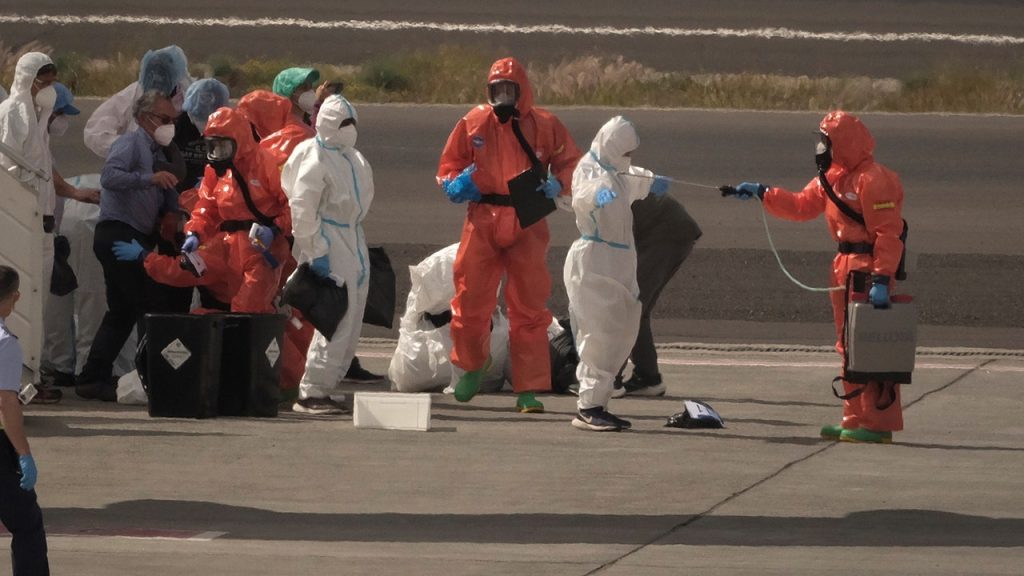
Dr. David Brett-Major of the University of Nebraska Medical Center has taken a lead role in returning Americans exposed to the Andes strain of hantavirus from the MV Hondius in Tenerife to quarantine and biocontainment in Nebraska and Emory. This piece follows his work on a specially configured flight, details the biocontainment setup on board, and highlights the team’s care priorities, including the mental health of those held for 42 days. It also mentions Phoenix Air Group support and voices from fellow clinicians like Dr. Craig Spencer.
Dr. David Brett-Major is an infectious disease physician and epidemiology professor known for quarantining and isolating patients exposed to high risk pathogens in resource limited settings with smart, creative, resourceful colleagues. He has worked extensively in sub-Saharan Africa and returned to Nebraska to help lead a State Department-organized mission that repatriated eighteen passengers from Tenerife. Fifteen of those passengers were directed to the National Quarantine and Biocontainment Unit in Omaha while two were sent to Emory for specialized care.
Brett-Major insisted there were no “unmanaged surprises” during the flight from the Canary Islands to Omaha, and that control and planning were the priority from takeoff to handoff. He and his colleagues thought through every role, every piece of equipment, and how to keep caregivers and patients safe during transit. That calm, methodical approach is rooted in years of fieldwork and military medical experience that shaped the team’s response.
He described the aircraft layout with a mixture of practicality and blunt observation. “It is a stripped aircraft,” he said, and he went on to explain the interior. “It does not have a lot of insulation. It has a lot of noise. I go on board, almost expecting old C-130 bucket seats, and instead what I see are groups of about 12 seats or 12 to 16 passenger seats, like on an airline, and they are sitting on a metal plate, and the metal plate is in sort of industrial tracks so that it can be rolled and moved around the aircraft.”
The front of the plane had been cleared and 23,000 pound biocontainment canisters were loaded to support those who needed intensive care during the flight. One passenger, Dr. Kornfeld, had a weakly positive hantavirus test and required a fully equipped container; another passenger showing symptoms was transferred to Emory. The canisters function as mobile treatment spaces designed to keep contagion contained while allowing clinicians to provide critical interventions.
“It is a mini-intensive care unit inside a container that comes on board the front of the aircraft like any other cargo. People inside are either health care workers or those who’ve entered isolation, and there are four beds that have usual hospital monitors and, you know, carrying cases with all the usual supplies that, you know, nurses and medics and physicians use and critical care.”
Part of the air support came from Phoenix Air Group, a team with experience in international ambulance and military-style medical evacuations. Brett-Major himself has a long history as a U.S. Navy medical officer and brought that operational perspective to the mission. On board, the team balanced clinical intensity with human connection, planning the space so returning Americans would not feel abandoned while remaining safe.
They talked about “how we might best use the airframe as a space so that people can be engaged with the team, those coming home and not feel too isolated. While also at the same time keeping everyone safe.” Roles were distributed and levels of personal protective equipment were matched to task. Brett-Major described wearing a gown, double gloves, an N95 mask, and a face shield in a coaching role, while Phoenix Air staff used higher level PPE like personal respirators with full hoods and coveralls during longer shifts.
Back in Nebraska, the quarantine and biocontainment teams focused as much on mental health as on clinical monitoring, knowing the psychological cost of prolonged isolation. Those exposed to hantavirus face a 42-day watch period, and the staff worked to keep people connected with loved ones and occupied during that time. Dr. Craig Spencer, who survived Ebola in 2014, put the isolation in sharp perspective when he said, “Imagine trying to be locked in one spot for five weeks. It’s really, really hard. I spent 19 days in an isolation facility at Bellevue Hospital being treated. That’s half the time these folks would have to stay. Think about what it means for their own lives, for their family, for their mental health, for their physical health.”
HANTAVIRUS DEATHS ON CRUISE SHIP HIGHLIGHT DANGERS OF RODENT-BORNE DISEASE