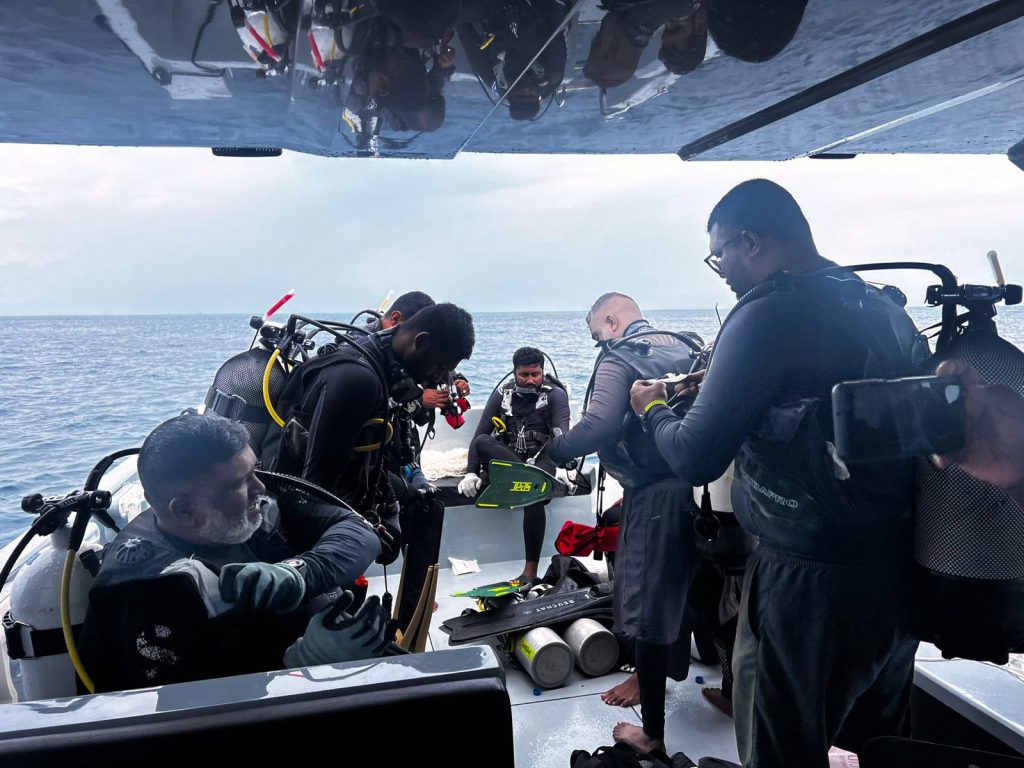
The Maldives search effort stalled after a Maldivian military diver, Mohamed Mahudhee, died attempting to reach a group of missing Italian divers believed trapped in an underwater cave at Vaavu Atoll. President Mohamed Muzzu attended a ceremony honoring Mahudhee as officials paused recovery operations to await specialized Finnish cave-diving experts and reassess safety. The five Italians included scientists and an instructor, among them Monica Montefalcone and Gianluca Benedetti, and the incident has prompted both a criminal probe and diplomatic condolences from Italy’s Antonio Tajani. Authorities have now focused on careful, technical planning as weather, depth and decompression risks complicate any return to the cave.
Maldivian authorities said they suspended the hunt for the four missing Italians after Mahudhee succumbed to decompression sickness following a rescue dive, highlighting how dangerous the site is. The group of five is believed to have been exploring a cave system near Vaavu Atoll at roughly 50 meters, far deeper than the Maldives’ recreational limit of 30 meters. That gap between local rules and the depth involved has become central to investigators trying to determine what went wrong and why. Rough seas and poor conditions have repeatedly slowed response teams, making every attempt riskier than usual.
Officials reported that one body, belonging to diving instructor Gianluca Benedetti, was found close to the mouth of the cave on Thursday, and teams believe the others pushed deeper into the passageways. The Italian Foreign Ministry said divers had mapped and marked the cave entrance earlier, but narrow tunnels, shifting sediment and oxygen limits made thorough exploration difficult. The cave is divided into three sizable chambers linked by tight passages, and recovery teams only managed to search two of them before safety concerns cut operations short. Those physical constraints, coupled with decompression needs, forced a pause while specialized help was sought.
The Maldives has requested three Finnish cave-diving specialists to arrive on Sunday to rethink the approach, and officials emphasized they will redesign the plan rather than rush back in. President Mohamed Muzzu is involved at the highest level: he visited the site, received briefings on the rescue plan, and attended the funeral honors for Mahudhee. Mohamed Hussain Shareef, the presidential spokesman, said the death made clear the mission’s difficulty, stating “The death goes to show the difficulty of the mission.” Local teams have continued limited dives in shifts, but authorities are balancing recovery goals with the risk to more lives.
The identities of the missing and deceased were confirmed by Maldivian officials and academic sources. The five were named as Monica Montefalcone, an associate professor of ecology at the University of Genoa; her daughter Giorgia Sommacal; marine biologist Federico Gualtieri; researcher Muriel Oddenino; and Gianluca Benedetti. Montefalcone and Oddenino were in the Maldives on an official scientific mission to study coral and climate impacts, though the university clarified that the fatal scuba activity was “undertaken privately.” The two students were not part of the official research assignment, according to university statements.
Family members have struggled to accept the sudden losses. Carlo Sommacal, husband of Montefalcone and father of Giorgia, questioned how such experienced divers could be lost, saying “something must have happened down there” given their skill and discipline. He described Monica Montefalcone on Italian television as careful and methodical, arguing she would not have knowingly put others at risk. Those comments feed into a larger inquiry into whether the dive exceeded planned limits and whether adequate equipment and permissions were in place.
The tour operator that arranged the trip, Albatros Top Boat, denied knowledge of any plan to descend beyond 30 meters, with lawyer Orietta Stella telling Italian media the operator “did not know” the group intended a deeper dive. Stella said the operator marketed the cruise and did not own the vessel or crew, which were locally hired, and that permission would have been required for dives past the 30-meter recreational cap. Investigators are examining whether the divers used standard recreational gear or more specialized technical equipment suited to deep cave environments, since improper gear would sharply raise the danger.
Cave diving is widely acknowledged as an extreme activity that demands bespoke training, redundant air systems, precise navigation and strict adherence to decompression protocols. Most recreational certifying agencies set limits near 30 to 40 meters, with anything deeper considered technical diving that requires extra certification and gear. Inside caves, the inability to ascend directly makes every dive markedly more perilous: silt can reduce visibility to zero, passages can confine movement, and narrow tunnels can prevent quick exits. Those realities framed rescue team decisions as they weighed the chance of recovery against the chance of new casualties.
Italian authorities said about 20 other nationals from the same expedition aboard the vessel Duke of York remain safe, and Italy’s embassy has been coordinating consular help and psychological support for those affected. Italy’s Foreign Minister Antonio Tajani offered condolences and affirmed efforts to bring victims home, while Maldivian officials have suspended the Duke of York’s operating license pending investigation. As Maldives teams prepare for the arrival of Finnish experts, the focus remains on meticulous planning, safety and uncovering the sequence of events that turned a scientific trip into a deadly nightmare.