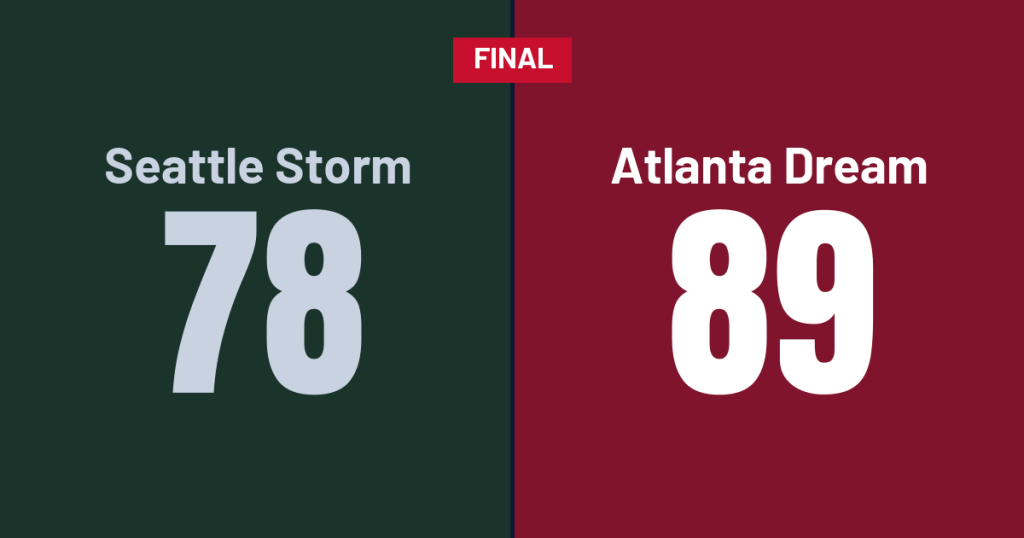
The Atlanta Dream picked up a convincing home victory Thursday night at Gateway Center in College Park, Georgia, dispatching the Seattle Storm by a final score of 89-78 to give the home crowd plenty to celebrate.
Allisha Gray was the engine of Atlanta’s offense, pouring in a game-high 22 points to pace the Dream. She received strong support from the rest of the roster, with point guard Jordin Canada orchestrating the attack to the tune of 8 assists — the most by any player on either side. Up front, Angel Reese was a force on the glass, hauling in 11 rebounds to anchor Atlanta’s interior presence and help limit Seattle’s second-chance opportunities.
For the Storm, Natisha Hiedeman was the lone bright spot offensively, finishing as Seattle’s leading scorer with 20 points. Flau’jae Johnson did her best to keep the offense moving, distributing 5 assists, while Dominique Malonga was active on the boards with a team-best 9 rebounds. Despite those individual contributions, Seattle could never generate enough consistent offense to seriously threaten the Dream’s lead.
The numbers behind Seattle’s loss tell a clear story. The Storm connected on just 3 of their 20 three-point attempts, a frigid 15 percent clip from beyond the arc that made it nearly impossible to keep pace with Atlanta. While Seattle shot a respectable 45 percent from the field overall and converted 15 of 19 free throws, the three-point drought left them perpetually chasing the game. Perhaps most damaging was Seattle’s turnover problem — the Storm committed 21 individual turnovers, and when team turnovers are factored in, that total ballooned to 23 giveaways on the night. Those miscues handed Atlanta repeated opportunities to extend its advantage and take control of the contest.
Seattle did show some fight on the defensive glass, pulling down 29 defensive rebounds as part of a 35-rebound total, and the Storm’s 21 assists indicated they were moving the ball with purpose. But 6 steals and 3 blocks were not enough to compensate for the turnover deficit and the inability to knock down perimeter shots when it mattered most.
Atlanta, playing in front of its home fans at Gateway Center, capitalized on every Seattle miscue and got balanced contributions across the lineup. Canada’s playmaking kept the Dream’s offense in rhythm, Gray’s scoring provided a reliable go-to option, and Reese’s rebounding gave Atlanta the kind of second-chance edge that Seattle simply could not match.
The 11-point victory is a strong result for the Dream, who controlled the game at home and demonstrated the kind of depth and execution that can carry a team deep into the WNBA season. Seattle, meanwhile, will need to address its turnover issues and find a way to generate more consistent production from the perimeter if it hopes to bounce back in its next outing.