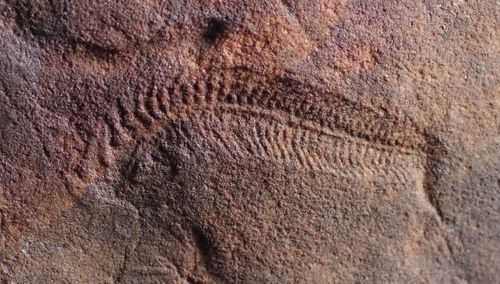
Fossils of an ancient sea creature, Spriggina floundersi, have revealed the earliest evidence of right-handedness in animals. The creature, which lived around 550 million years ago, had a tendency to bend to the right, according to a recent study published in the journal Scientific Reports.
The Discovery
The fossils of Spriggina were first discovered in 1958 in what is now South Australia. The creature had a flat, segmented body and a large, curved structure at one end, making it the earliest known animal with a head. Researchers have been studying the fossils to determine whether the creature could move on its own and have found that it could wriggle across the seafloor.
The study found that the fossils of Spriggina showed a preference for bending to the right, with about twice as many fossils bending to the left as to the right. This suggests that the creature had a nervous system connected to its muscles, allowing it to curve in a preferential direction.
Implications
The discovery of right-handedness in Spriggina has implications for our understanding of the evolution of directional preference in animals. The creature set the stage for the development of this trait in other animals, including humans, primates, mice, frogs, and insects.
According to Scott Evans, the lead author of the study, the discovery of right-handedness in Spriggina is a significant finding. “Fossils of early animals, to most people — even to me — they look weird,” he said. “But if you push past that weirdness, what we see is that a lot of the fundamental characters that we associate with animals today, things like the ability to move and even having this behavioral handedness, are present in these earliest animal communities.”
Original reporting: 40/29 / KHBS (NW Arkansas) — read the source article.