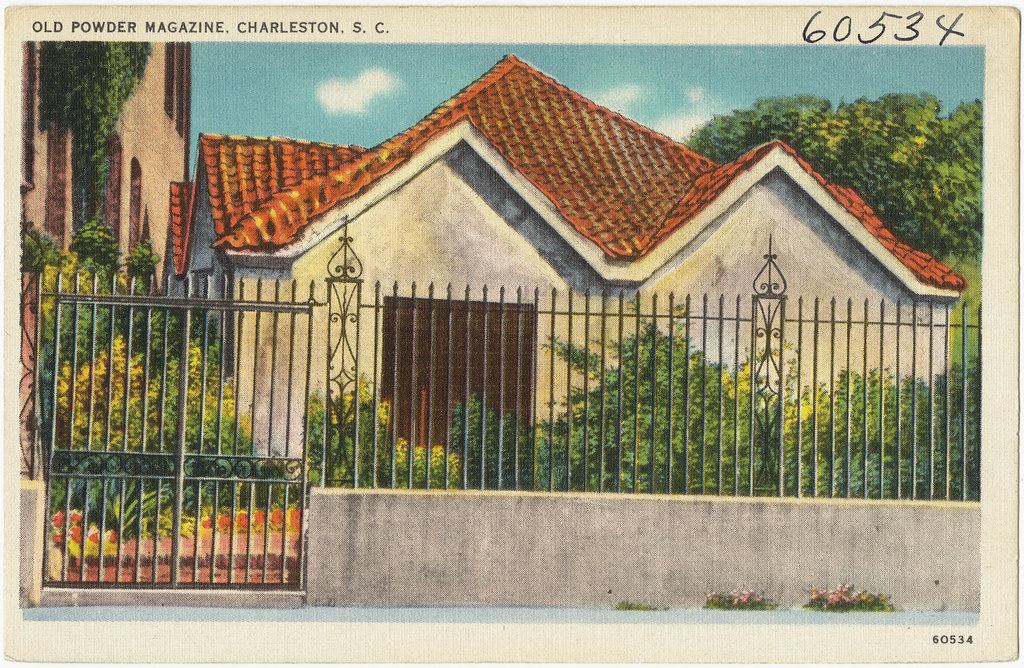
There is a small, squat, almost fortress-like building tucked quietly on Cumberland Street in the heart of Charleston’s French Quarter neighborhood, and most visitors walk right past it without a second glance. That, frankly, is their loss — because the Powder Magazine is one of the most fascinating, atmospheric, and genuinely moving historic sites in the entire American South.
Built between 1712 and 1713, the Powder Magazine is the oldest surviving public building in the former British colonies south of Virginia. Let that sink in for a moment. This building was storing gunpowder and defending a fledgling colonial settlement while most of what we now call the United States was still untamed wilderness. It has survived wars, earthquakes, hurricanes, fires, and centuries of Southern humidity, and it is still standing — thick tabby-and-brick walls and all — right there on Cumberland Street, waiting for you to walk through its heavy wooden door.
The building served as the colonial government’s primary gunpowder storage facility for decades, a critical function in a city that was constantly bracing against threats from Spanish forces, pirates, and Native American conflicts along the frontier. Its architecture reflects that anxious purpose: the walls are several feet thick, the distinctive four-sided gambrel roof was specifically engineered to blow upward rather than outward in the event of an explosion, minimizing damage to the surrounding city. When you stand inside and look up at that ceiling, knowing the engineering logic behind it, history suddenly feels remarkably human and immediate.
The Powder Magazine is operated by the National Society of The Colonial Dames of America in The State of South Carolina, and they have done a wonderful job transforming the interior into a thoughtfully curated exhibit space. You will find rotating displays of colonial-era artifacts, weapons, textiles, and maps that paint a vivid picture of what life in early Charles Towne actually looked like — not the romanticized version, but the real, complicated, gritty one. Interpretive panels are well-written and genuinely informative without being exhausting, making this an ideal stop for curious adults and history-minded older children alike.
Admission is very affordable, the building is compact enough to explore thoroughly in about forty-five minutes, and the location puts you squarely in the middle of Charleston’s most walkable historic district. You can pair a visit here with a stroll down Church Street, a stop at a nearby café, or a wander through St. Philip’s churchyard just a block away.
What I love most about the Powder Magazine is that it asks nothing of you except your attention. No flash, no spectacle — just nearly three hundred years of history held inside a remarkable set of walls. In a city full of grand mansions and sweeping plantation gardens, there is something quietly powerful about standing in a small, humble structure that has simply refused to disappear. Charleston’s story did not begin in the ballrooms. It began in places like this.
Do yourself a favor and find it.