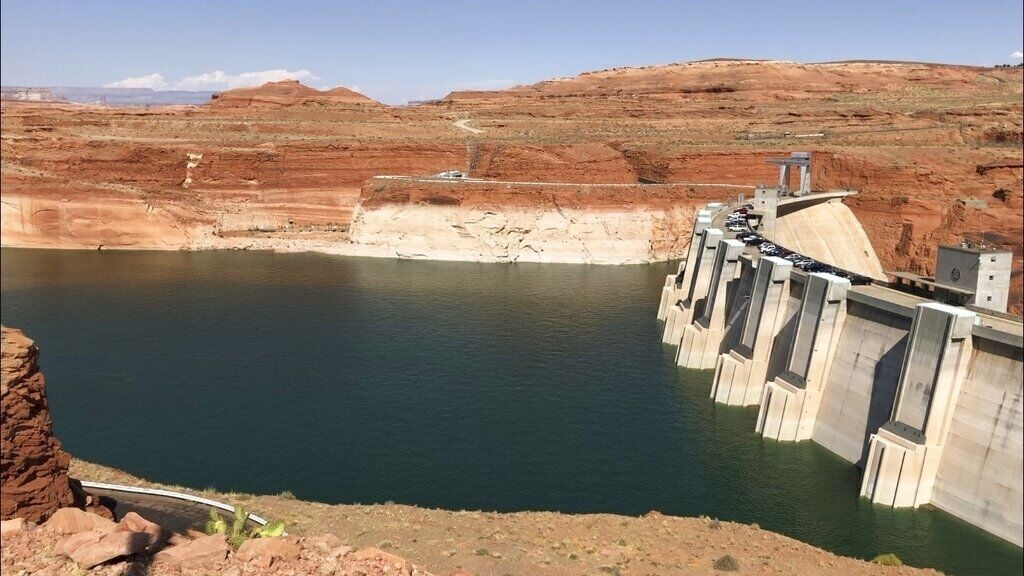
The U.S. Bureau of Reclamation announced a two-part plan to shore up Lake Powell this year amid record low snowpack and forecasts for unusually low inflows. Officials will boost inflows to Powell by releasing between 660,000 and 1 million acre-feet of water from Flaming Gorge reservoir on the Wyoming‑Utah border, while cutting planned releases from Powell to Lake Mead by nearly 20% — from 7.48 million acre-feet to about 6 million acre-feet.
The main goal is to prevent Powell’s elevation from falling below 3,490 feet, a level at which the Glen Canyon Dam turbines could stop producing power. If levels drop further, water would have to be sent through lower-capacity steel outlet works rather than turbines, a method not meant for prolonged large-volume flows and one that would reduce the dam’s ability to pass water downstream.
Forecasts from the bureau show the risk is real: without intervention, Lake Powell could dip below 3,490 by late summer. In a lower-probability scenario the agency projects a possible level of about 3,482 feet by August; the agency’s “most probable” forecast indicates a chance of falling below 3,490 by September. With the new actions in place, the bureau says it should hold Powell near about 3,500 feet through April 2027, versus a modeled drop to roughly 3,446 feet without those measures.
Shifting releases to protect Powell will have downstream consequences. Reducing outflow to Lake Mead is likely to curb power production at Hoover Dam — the bureau has warned generation capacity could fall by as much as 40% — and could hasten declines in Mead’s elevation. If Mead drops below about 1,035 feet, several Hoover turbines would need to be taken offline, and modeling indicates it could reach that threshold by mid‑2027 without further adjustments.
Beyond hydropower impacts, the drought response will affect recreation and river operations: boating access at some upper Colorado River basin reservoirs may be limited sooner in the season, rafting conditions in the Grand Canyon will change with lower flows, and fishing could become more difficult. The bureau says it is coordinating with the seven basin states, tribal nations, Mexico and other partners as negotiations continue about longer-term Colorado River management; if those talks do not produce a multistate agreement soon, federal agencies indicate they will move forward with their own operational plans. The agency also stressed that, for this year, the cut to releases from Powell is not expected to reduce the volume of Colorado River water delivered to cities and farms supplied from Lake Mead.