A hiker in the Austrått district of Sandnes, Norway, recently uncovered a sixth-century gold scabbard fitting, a tiny but extraordinary piece linked to a local power center at Hove and now studied by the University of Stavanger. Archaeologist Håkon Reiersen and museum director Kristin Armstrong-Oma are leading the research and will display the find at the Museum of Archaeology at the University of Stavanger. The discovery has locals and scholars excited about what it reveals of Migration Period leadership in Rogaland.
The find began with a routine walk after a storm felled a tree in Austrått, a neighborhood in Sandnes on Norway’s southwest coast. The anonymous hiker, who is a father of two, said he “like[s] to explore and get to know the local area.” He noticed a slight change in the soil beneath the uprooted tree and began to poke with a stick, an action that turned up something unexpected.
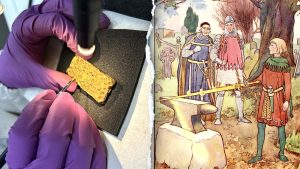
“I saw a slight rise in the soil under the tree and poked at it with a stick,” he recalled, then added, “Suddenly I saw something gleaming. I didn’t quite understand what I had found.” What he pulled from the earth was not a full blade but a richly decorated gold fitting from a sword’s scabbard, measuring about six centimeters at its widest. Small in size, it carries outsized meaning because such items are exceptionally rare in Northern Europe.
Experts tied the object to the sixth century, a time scholars call the Migration Period after the fall of the Roman Empire. That era was marked by shifting power, regional chiefs, and visible displays of rank and loyalty. The gold fitting likely once decorated the scabbard of a sword worn on a belt, the ornament that announced who held authority in the landscape around Hove.
Archaeologist Håkon Reiersen described the discovery as “spectacular.” He explained how unusual it is to find such an object in Rogaland and how it changes the map of elite material culture in Norway. “You are completely taken by surprise when finds like this appear. The odds of finding something like this are minimal,” he said, underscoring the rarity and scholarly importance of the piece.
Reiersen also offered a sense of the social world behind the object, observing that the sword’s owner “was likely the leader in this area in the first half of the sixth century, with a retinue of loyal warriors.” The fitting itself shows signs of wear, suggesting it was not merely a ceremonial token but part of daily display and use. That wear signals a living history: a person who actually carried a sword and used it, not just someone who owned one as a showpiece.
Archaeologists think the fragment was deliberately concealed, probably placed in a rock crevice as an offering to the gods. Officials note that the Migration Period was not just politically unstable but could be environmentally harsh, and “At that time, there were crop failures and crisis, and people likely deposited valuable objects as offerings in hopes of better times.” Burying valuables as votive gifts fits a pattern seen across Northern Europe where objects moved from mundane life into ritual contexts.
Only a small number of comparable gold scabbard fittings have been recorded in Northern Europe—this makes the Sandnes discovery one of roughly 18 known pieces and the first of its kind in Rogaland. That scarcity elevates the object’s value for researchers studying elite networks, metalwork, and symbolic power during the sixth century. The Museum of Archaeology at the University of Stavanger will host the piece so both specialists and the public can examine it up close.
Kristin Armstrong-Oma, the museum director and a professor, praised the finder and highlighted the collaborative research to come. She said she “extend[s] a big thank you to a very observant hiker,” and noted that “[The hiker gave] us a new puzzle piece connected to the power center at Hove during the Migration Period.” Armstrong-Oma added that the museum has some of the world’s leading researchers on such objects, a team ready to dig into ornamentation, manufacture, and context to build out this slice of regional history.
The plan is to make the fitting public so people can view and learn from it, and Armstrong-Oma promised that “This find will be made available to the public, so people can see it and share in the gold fever with us.” While the piece itself is small, its story reaches into questions of leadership, ritual practice, and how communities in what is now Rogaland coped with crisis. For a single gleam under a storm-felled tree, the discovery offers a vivid, human-sized link to Norway’s turbulent sixth century.