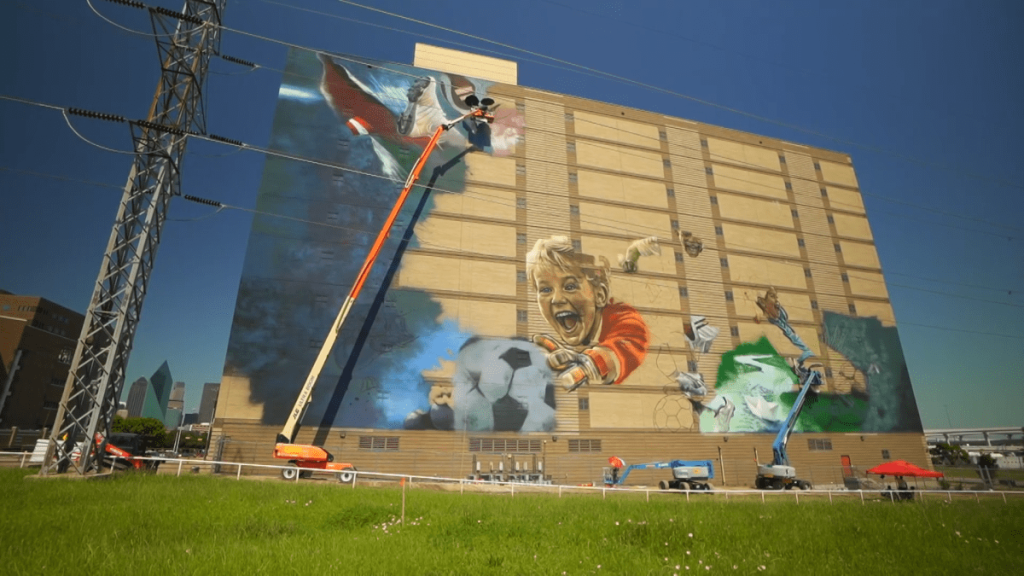
Work has begun on what will be the largest public art mural in Dallas, installed ahead of the 2026 FIFA World Cup that kicks off June 11, and it sits overlooking the future 250-acre Harold Simmons Park. The piece is being painted on the Trinity Park Conservancy building at 305 W Commerce Street, and it involves international and local artists, nonprofits, and city-facing placemaking efforts tied to the World Cup crowd. Artists ROOSART and Daniel Yanez are central to the project, with Street Art for Mankind curating and producing the installation. Trinity Park Conservancy leadership, including Tony Moore, has framed the mural as a bridge between sport, nature, and community.
Crews are actively installing the mural now, racing to have it finished by the end of the month so it can greet early visitors and local passersby. The work is deliberately visible from multiple neighborhoods, sitting between downtown Dallas, the Design District, and Trinity Groves, so it functions as both a landmark and a welcome for the many people expected here for 2026. The mural’s scale makes it a prominent statement about public art ambitions in the city, and the deadline creates a palpable sense of momentum. That urgency is part of the point: to present a bold, international-facing image before the tournament begins.
The site itself, the future Harold Simmons Park, is a separate, massive undertaking slated to be built over the next few years and is not expected to be complete until 2028. At 250 acres, the park will reshape that stretch of the riverfront and create new connections to the river, trails, and recreation spaces for Dallas residents. The mural overlooks that future green space now, acting as a visual promise of what the park will become and as a temporary activation for a neighborhood in transition. Planners see the artwork as an early cultural amenity that signals long-term investment.
The team behind the piece blends international renown and local roots: ROOSART brings a global profile, Daniel Yanez offers a Dallas-based perspective, and Street Art for Mankind is producing and curating the whole effort. That nonprofit is known for mobilizing street art around environmental and social issues, and here they are positioning the mural as more than decoration. It will be a conversation starter for visitors and neighbors alike, connecting visual storytelling to broader civic priorities. Organizers say the goal is to use the mural to connect art, community, and the outdoors for thousands of international visitors.
Beyond the artists and producers, the Trinity Park Conservancy is the host and steward for the wall at 305 W Commerce Street, and the mural will tie into their larger mission for the riverfront. The conservancy’s role is to maintain public space and create programming that encourages use of parks and trails, and a major mural fits squarely within that strategy. By placing high-impact public art on a visible conservancy building, the group amplifies its presence and offers a high-profile touchpoint for visitors arriving during the World Cup. The mural becomes both an attraction and a civic marker for the conservancy’s work.
Public reaction so far has been upbeat, with many locals already sharing images as sections of the design go up and visitors pausing to watch the paint crews. The timing with the World Cup adds a global layer to what would otherwise be a city-focused public art project, attracting attention from international travelers expected in Dallas next summer. That audience shapes choices about scale, imagery, and placement, since the mural needs to read well from a distance and in photographs. For the city, it’s an opportunity to present a snapshot of Dallas culture to a broad, international crowd.
Funding and logistics for a mural of this scale involve coordination between nonprofits, city agencies, and private partners, and the tight timeline means planning had to be precise. Equipment, permits, and site prep all had to align so the project could begin painting without delay, and the mural team has had to balance artistic ambitions with practical constraints at a major urban site. Even so, the collaborative approach has kept the project moving and allowed artists to work at scale. For residents, the visible progress is a sign that the project will meet its near-term completion goal.
“Soccer, at its core, is about bringing people together — just as Harold Simmons Park will bring Dallas closer to nature and to each other. This mural is where those two visions meet.” – Tony Moore, CEO, Trinity Park Conservancy. The quote captures the explicit connection organizers are making between the sport, the soon-to-be park, and the public artwork intended to welcome a diverse crowd. It also spells out the mural’s dual role as both civic gesture and visitor-facing beacon during an international event. For many involved, the mural represents a small but visible piece of a larger vision for the riverfront.
The mural is expected to be finished by the end of the month, providing a striking backdrop long before Harold Simmons Park is completed in 2028, and it will remain a lasting marker of this moment in Dallas civic life. As installation wraps, attention will turn to how the wall is activated during World Cup events and how it fits into the ongoing development of the park and surrounding neighborhoods. For now, the work offers residents and incoming visitors alike something immediately tangible: color, scale, and a story about Dallas stepping into a bigger spotlight. The collaboration between ROOSART, Daniel Yanez, Street Art for Mankind, and the Trinity Park Conservancy makes that story visible from the riverfront and beyond.