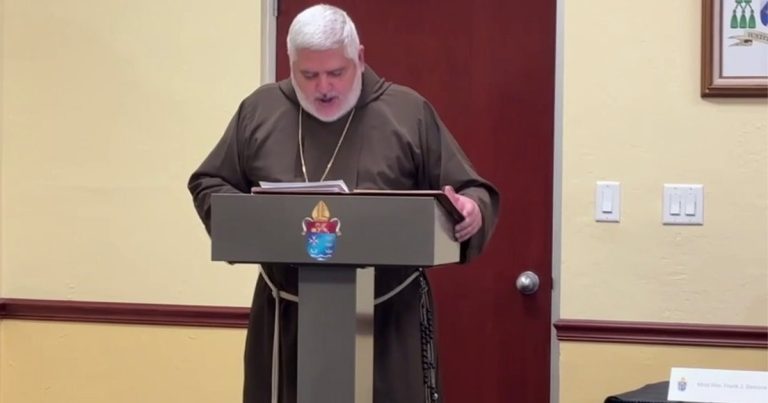
Preamble: Pope Francis has named Franciscan priest Emilio Biosca Agüero to lead the Diocese of Venice as Bishop Frank Dewane prepares to retire after 20 years of service in Venice, Florida. The change reaches across a diocese that stretches roughly from Palmetto through Collier County, and Bishop-elect Biosca will be installed in a July 11 church ceremony. Both men have signaled a steady focus on pastoral care and social ministry as the handover approaches.
Bishop Frank Dewane, 76, announced his decision to step down after two decades guiding a sprawling diocese that covers more than 9,000 square miles. He introduced Bishop-elect Emilio Biosca Agüero as his successor, and the transfer of responsibilities is being framed as a continuation rather than a break in leadership. The scale of the Diocese of Venice — with coastal and inland parishes, retirees, seasonal communities, and immigrant families — means the new bishop steps into a complex pastoral map.
Emilio Biosca Agüero brings a long record of missionary work and Franciscan formation to the role: he is a Cuban American ordained for the Order of Friars Minor Capuchin who served more than a decade in Papua New Guinea and 12 years on a mission in Cuba. The appointment reached him while he was hearing confessions at the Shrine of the Sacred Heart in Washington, D.C., and he described the moment as unexpected. “It’s a big surprise. I’m still adjusting to the surprise, but certainly it means tremendous support from the Holy Father and Holy Church,” Biosca said.
Bishop Dewane framed his retirement as a timely handoff, saying plainly, “I’m ready to retire because I think we all have a contribution to make in our time in the world.” He emphasized that appointments come as part of a broader providential plan: “To me, the Lord sends what is needed and to me, he has sent what is needed here in this man.” That sense of mission and reliance on providence has shaped Dewane’s public ministry and will influence how the diocese marks his departure.
Pastoral priorities are already taking shape around social welfare and immigrant care, reflecting the realities of the diocese’s demographics. While in Washington, D.C., Fr. Biosca shepherded a multicultural parish through a crisis when 95 of its parishioners were detained by ICE, and he described his role as responding to immediate human needs as they appeared. “I think the experience at Sacred Heart was that it grew that way. It grew naturally,” Biosca said. “We didn’t go out to find a response. The response came because there were people who were looking for help and people from the parrish.”
That experience dovetails with what local leaders say the diocese needs: a bishop comfortable with outreach, bilingual ministry, and the logistics of coordinating services across retirement communities, seasonal populations, and immigrant neighborhoods. Biosca himself pointed to evangelization and the presence of Hispanic and other immigrant groups as possible reasons for his selection. “Noting the work of evangelization is so important, and there is a Hispanic community and other immigrant communities here in the diocese, perhaps that has something to do with it,” Biosca said.
Practical preparations are moving toward the July 11 installation, when Fr. Biosca will officially be consecrated and take on the full responsibilities of bishop. He framed the appointment as both an invitation and a call to trust: “It means noting how God works in our lives. He invites us to do new things even if we are not ready or totally prepared, but to trust in god and begin to walk,” Fr. Biosca Agüero said. Parishes across Venice will be turning their attention to pastoral planning, outreach, and the continuity of ministries that address food security, housing, and immigrant assistance.
Local clergy and lay leaders are talking about continuity more than rupture, with an eye toward preserving programs built under Dewane while allowing Biosca to bring fresh energy from his missionary background. There is public interest in how the new bishop will balance sacramental life, parish stability, and advocacy work for vulnerable people. As the community waits for the official rite of installation, many parishioners say they hope for steady leadership and clear pathways for expanded bilingual services and immigrant support.
For Bishop Dewane, the move toward retirement has been presented as a chance to hand a healthy diocese to a successor who knows missionary work and multicultural ministry firsthand. For Bishop-elect Biosca, the assignment to Venice is a return to pastoral leadership in a very different American setting, one that brings coastal retirees, immigrant families, and seasonal shifts into daily parish life. Both men are signaling that caring for the most vulnerable will remain central to the diocese’s direction as the transition unfolds.