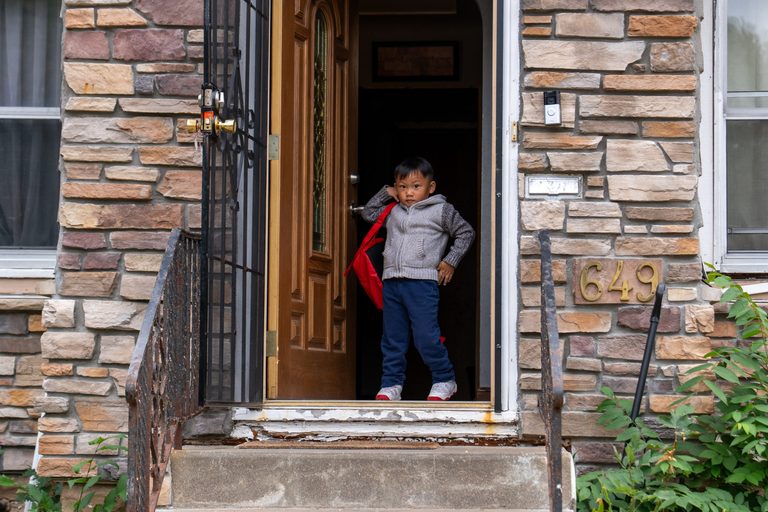
South St. Paul – When Zong Yang was taken by federal agents in February as part of Operation Metro Surge and deported to Laos in May, his wife Linda was left to care for five boys on her own. The family’s daily routine now hinges on technology, faith, and a deep commitment to keeping their traditions alive.
Morning routine reshaped
Every weekday, Linda wakes early to get her youngest, King (3), ready for preschool. She drops him off around 8:50 a.m., then drives him to a relative’s house while she works from home until 11 a.m. The older boys – Titan (7), Everest (9), Kenji (15) and Yaay (17) – catch the school bus on their own, a task Zong once oversaw from the front lawn.
Because Laos is 12 hours ahead, Zong can still greet his sons each morning through a Ring camera installed at the front door. He watches them get dressed, waves to the bus, and offers words of encouragement. “It works out good; it gives me a little peace back,” he told the Sahan Journal. The brief video calls, lasting about 45 minutes, are the family’s lifeline.
Balancing work and parenting
Linda, 41, now works double shifts – a remote stint in the morning and an in‑person role at her office later in the day. She also coordinates childcare for King and manages the household’s finances. “We were always trying to figure out what we needed to do, or how we’re going to make it work,” she said.
Before his removal, Zong worked the overnight shift at Home Depot in Inver Grove Heights, returning home before dawn to help the boys with their morning routine. He set three alarms to remind himself of brushing teeth, dressing, and getting out the door. Those structured mornings are now a memory, but the family strives to preserve the rhythm.
Staying connected across continents
Zong has begun sharing videos of his new life in Vientiane on Facebook, showing trips to the zoo and daily activities. Occasionally, the boys watch these clips together, imagining what it would be like if their father were still home. “Dad would take us too, right?” Titan asked, and Linda answered, “Yes, he would have taken you.”
Phone calls remain a crucial thread. Linda and Zong discuss school events, future plans, and the possibility of Zong obtaining Lao citizenship and a passport so the family could travel together someday. “We can’t look at it like this is the end,” Linda affirmed.
Faith and hope sustain the family
Both parents lean on their Christian faith to navigate the hardship. Linda describes moments of quiet reflection, wondering, “Why am I here by myself?” yet she finds strength in prayer and the support of their church community. Zong, though unemployed in Laos, volunteers to teach a friend’s son English, learning through YouTube tutorials.
The family also sends physical photos back and forth – soccer practices, kite‑flying, and fair‑day outings – ensuring that memories stay tangible. “It’s never a day that passes by that we don’t think of him,” Linda said.
Looking ahead
As the boys grow, the Yangs are planning for the long term. Yaay is now a student at Winona State University, while Kenji prepares for his senior year of high school. The parents hope that, once the younger children are independent, they might consider retiring together in Laos, reuniting the family under one roof.
For now, the Yang household exemplifies resilience: a mother balancing work and parenting, a father maintaining presence through a screen, and five children learning to thrive despite the distance. Their story underscores the power of family, faith, and perseverance in the face of immigration enforcement’s toughest consequences.
Original reporting: Sahan Journal — read the source article.