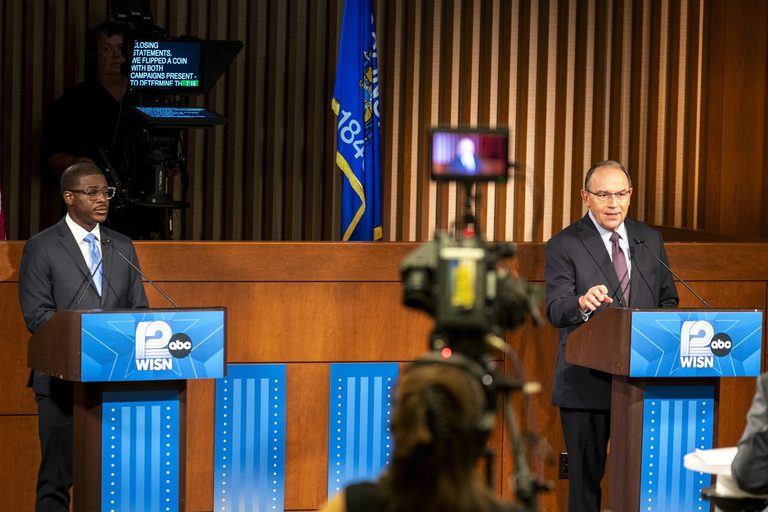
On Wednesday night, Wisconsin voters watched the governor’s race debate between Democrat David Crowley and Republican Tom Tiffany. Both candidates used the stage to outline their priorities for families, schools and the state’s economy.
Key topics and time allocation
The longest segment for each candidate was school funding, with both men speaking for more than four minutes on the issue. Their discussion covered private school vouchers, public‑school financing and the need for increased state support. Taxes came in second, as the candidates debated income‑tax policy, the state budget surplus and property‑tax relief.
While most topics received roughly equal airtime, Tiffany spent three minutes and 37 seconds—about two minutes longer than Crowley—explaining why he voted against certifying the 2020 presidential election results. He cited “Zuckerbucks,” referring to the grants from Mark Zuckerberg and Priscilla Chan that helped Wisconsin run elections during the pandemic. Tiffany argued those funds were an attempt to privatize election administration, a practice Wisconsinites rejected in a 2024 constitutional amendment.
Attack versus defense
Crowley adopted a more aggressive stance, spending roughly four minutes more than Tiffany in directly criticizing his opponent. He attacked Tiffany’s record on taxation, school funding and border control, even noting Tiffany’s past support for eliminating the U.S. Department of Education and large cuts to the University of Wisconsin system.
Tiffany, in turn, focused his criticism on Crowley’s appeal to voters who supported democratic‑socialist candidate Francesca Hong in the primary. He also accused Crowley of backing tax breaks for data‑center operators, while defending his own vote for President Donald Trump’s tax and spending package that included broad tax incentives for businesses, including data centers.
Data‑center debate
Both candidates spent less than a minute each on data‑center policy. Crowley charged Tiffany with supporting tax breaks for the industry, while Tiffany argued Crowley’s proposal to power data centers with wind and solar was unrealistic. The word‑cloud analysis showed Tiffany used the word “taxes” most often when attacking Crowley, emphasizing his claim that Crowley would raise tax burdens. Crowley’s most frequent attack word was “work,” questioning whether Tiffany would work for ordinary Wisconsinites or for wealthy interests.
Methodology note
Wisconsin Watch transcribed the debate using an AI speech‑recognition model and then manually corrected speaker‑identification errors. Each line was tagged by topic and tone, with “aggressive” lines defined as those directly criticizing the opponent. The analysis also corrected a tokenization error that had misidentified the word “taxes” as “taxis.”
Overall, Tiffany spoke about 200 seconds longer than Crowley, but much of that extra time was spent defending his own positions. Crowley, meanwhile, devoted more time to attacking Tiffany’s record on taxation, school funding and border control.
Original reporting: Wisconsin Watch — read the source article.