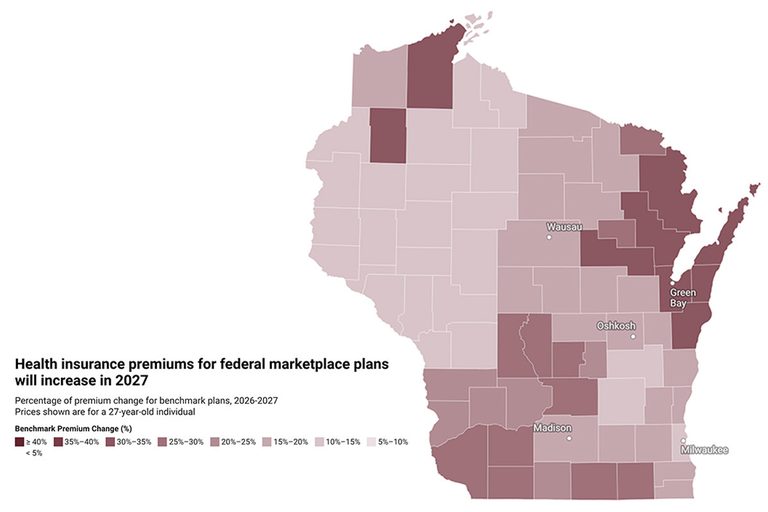
Wisconsinites who rely on the federal Affordable Care Act (ACA) marketplace will see a sharp jump in costs for 2027. According to a Wisconsin Watch analysis, the benchmark Silver plan – the second‑cheapest option used to calculate subsidies – is projected to increase by an average of 21.6% across the state. That follows a 17.4% rise last year.
County‑by‑county impact
Premium growth will not be uniform. Residents of Manitowoc, Marinette and Door counties in Northeast Wisconsin face the steepest hikes, with benchmark premiums expected to surge nearly 34%. To the northwest, Washburn and Bayfield counties will see increases around 33%, echoing last year’s 23% spike. Conversely, Dunn, Eau Claire, Chippewa, Pepin, Barron and Rusk counties are slated for the smallest rise – roughly 10%.
For a typical 27‑year‑old adult, the average benchmark premium will exceed $600 per month in 2027, up from under $450 just two years ago before the expiration of expanded premium tax credits. In four northern counties – Ashland, Bayfield, Washburn and Sawyer – a 27‑year‑old could face premiums above $700. Older shoppers will feel an even larger dollar impact; a benchmark plan for adults over 60 is projected to approach $1,600 per month.
Insurer participation and provider loss
The number of insurers offering plans in Wisconsin will remain steady at 12, but the marketplace’s geographic coverage will shrink. Eighteen counties will lose at least one provider next year, and Shawano County will lose two. No insurer has announced plans to expand its footprint in the state.
Fond du Lac County will be left with a single marketplace provider. Minnesota‑based Medica will withdraw ACA plans from 13 counties – Ashland, Barron, Bayfield, Burnett, Clark, Douglas, Marathon, Pierce, Polk, Rusk, St. Croix, Sawyer and Washburn – though it will continue offering plans outside the marketplace in those areas.
“Medica recognizes that changes in the health insurance market have a very real impact on individuals and families who rely on us today,” Medica spokesperson Greg Bury said in an email. “We are committed to supporting them through these transitions with clear, timely information and guidance as they consider their coverage options.”
Higher deductibles and cost‑sharing
In addition to higher premiums, half of the medical plans carried over from last year will raise deductibles. This includes 11 of 13 plans offered by HealthPartners. Quartz, one of the market’s larger carriers, will increase deductibles on more than 68% of its plans. Several insurers are also lifting co‑pays and co‑insurance rates, which could affect the cost of primary‑care visits, specialist appointments, prescriptions and outpatient mental‑health services.
State response and enrollment trends
Sarah Smith, director of public affairs for the Wisconsin Office of the Commissioner of Insurance, noted that the expiration of the expanded premium subsidies at the end of 2025 and reduced federal support for navigators have strained both affordability and plan availability.
Smith added that the Wisconsin Healthcare Stability Plan – launched in 2019 and funded by state and federal dollars to reimburse insurers for high‑cost individual‑market claims – helps keep premiums from climbing even higher.
Navigator program manager Adam VanSpankeren of Covering Wisconsin warned that rising costs could depress enrollment. The state’s ACA marketplace saw a drop of more than 22,000 enrollees from 2025 to 2026, the first decline since the pandemic. “When the prices go up, you can expect some kind of enrollment decrease,” VanSpankeren said, adding that employment changes also play a role.
He cautioned that higher prices could leave some residents without coverage: “If it’s just because of price and people are going uninsured, that’s obviously the concern.”
How to shop for coverage
The open enrollment period runs from Nov. 1 through Jan. 15, with plans taking effect on Jan. 1 for those who select coverage by Dec. 15. The state’s Office of the Commissioner of Insurance urges shoppers to work with a licensed insurance agent or broker, call a navigator at 608‑261‑1455 or 877‑942‑6837, or locate a certified application counselor online.
VanSpankeren emphasized that the process can be overwhelming and that the Covering Wisconsin program exists to help consumers navigate the complexities of the marketplace.
Wisconsin Watch is a nonprofit, nonpartisan newsroom providing original reporting on state issues.
Original reporting: Wisconsin Watch — read the source article.