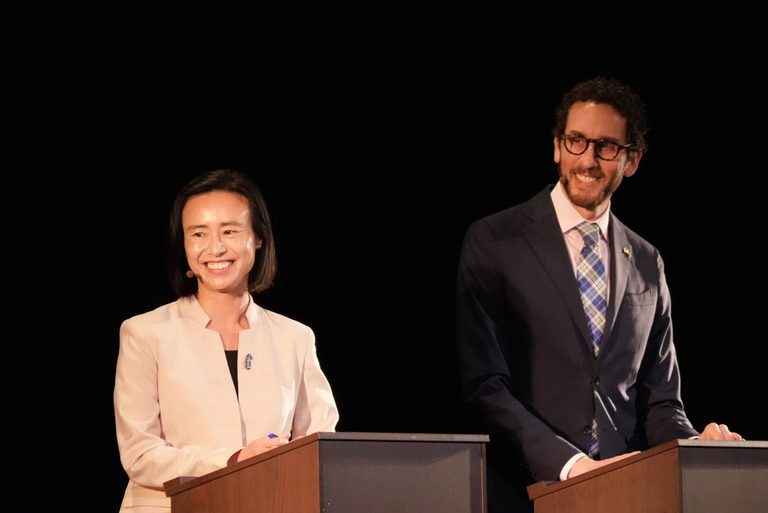
San Francisco voters saw a lively showdown Tuesday night at the Sydney Goldstein Theater as Senate hopeful Sen. Scott Wiener and Supervisor Connie Chan debated the future of artificial intelligence regulation, campaign financing, and the city’s housing crisis. The forum, co‑presented by City Arts & Lectures and moderated by Mission Local’s Joe Eskenazi and New York Times bureau chief Heather Knight, was the final debate before Election Day.
AI regulation takes center stage
Wiener opened by claiming he is the “only candidate” who has actually regulated the burgeoning AI industry, noting he introduced the nation’s first AI safety bill, SB 53, which passed in 2025 and is now being mirrored by several states. Chan challenged his record, asking, “How can we trust you to regulate AI with integrity, and not just placate the industry?”
Wiener responded that both the AI industry and “a gentleman by the name of Donald Trump” tried to sink his bill, emphasizing that big‑tech companies opposed the legislation. Chan countered that Wiener had “watered down” the bill after pressure from industry leaders, Gov. Gavin Newsom and Rep. Nancy Pelosi.
Funding controversy
During the debate, reporters highlighted a $3.5 million contribution to a pro‑Wiener independent‑expenditure committee from Public First Action, an AI‑policy advocacy group heavily funded by Anthropic. Wiener repeatedly asserted, “There’s no Anthropic money in the race,” a claim echoed by Public First Action spokesperson Anthony Rivera‑Rodriguez, who said Anthropic’s donations are restricted to public education, not candidates.
Chan seized on the issue, calling it “disappointing” that Wiener would say anything to win, and her campaign promptly posted a social‑media rebuttal labeling the candidate “lying.”
Housing and affordability
When the discussion turned to San Francisco’s notorious housing affordability, Wiener framed the city as a historic “boom‑bust town” and argued that the AI boom is not to blame. He said the real problem is the city’s long‑standing refusal to build enough housing, asking, “Why is San Francisco yet again unprepared with housing for the ups and downs of our economy?” Chan, however, advocated taxing AI firms that replace workers, insisting that automation should not become an incentive to erode the workforce.
Broader policy positions
Both candidates agreed that AI firms such as Anthropic and OpenAI should face civil penalties—and potentially criminal ones—for recent hacking attacks. They also called for the abolition of Immigration and Customs Enforcement and expanded pathways to citizenship.
On foreign policy, Chan urged the United States to prioritize humanitarian aid and diplomacy, while Wiener echoed a collaborative approach abroad. Both condemned Israel’s actions in Gaza, with Chan labeling them genocide and Wiener supporting a full arms embargo.
Personal touches and unity
In lighter moments, Wiener named the 24‑Divisadero Muni line as his favorite, while Chan preferred the 1‑California line. Their favorite local traditions included the Autumn Moon Festival for Chan and a “gay beach” at Dolores Park for Wiener. Both highlighted favorite night‑spots—Wiener praised the reopened Oasis bar, and Chan mentioned a late‑night drink at 540 Bar on Clement Street.
Despite the heated exchanges, the candidates ended on a conciliatory note, acknowledging their long‑standing campaign camaraderie. “We have to get along well,” Wiener said, and Chan added, “It’s been months.” Wiener concluded by honoring his opponent, saying, “What an honor it is to be on this stage with you.”
What’s next for voters?
San Franciscans will head to the polls next month to choose who will succeed Speaker Emerita Nancy Pelosi in Congress. The debate underscored stark differences on AI oversight, campaign finance transparency, and housing policy—issues that will shape the district’s future.
Original reporting: Mission Local — read the source article.