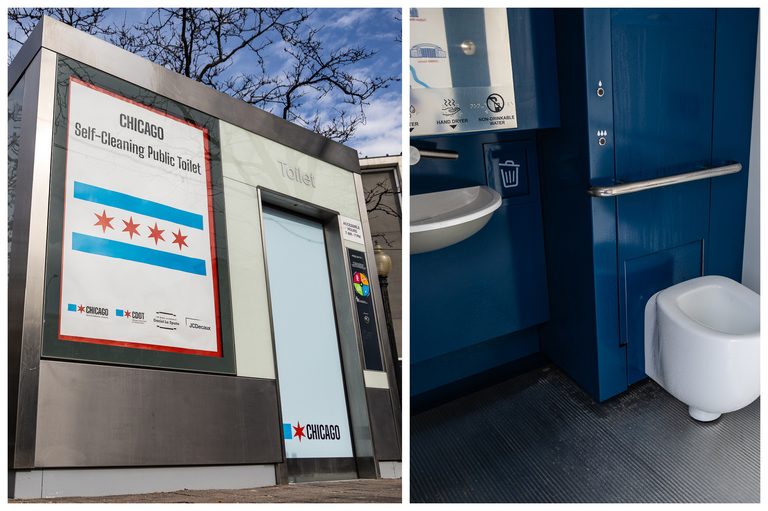
Chicago’s 1st Ward unveiled the city’s inaugural self‑cleaning public restroom on Wednesday at the Polish Triangle plaza, located at the Milwaukee, Ashland and Division intersection in Wicker Park. The facility, supplied by JCDecaux, operates daily from 7 a.m. to 7 p.m. and limits each use to 15 minutes, with a countdown clock and an automatic wash‑and‑disinfect cycle that starts after each user leaves.
Local leaders champion the amenity
Alderman Daniel La Spata, who held his young daughter during the ribbon‑cutting, called the toilet a “much‑needed public amenity” for residents of all ages, people experiencing homelessness, and anyone else who needs a clean restroom. He emphasized that the project reflects Chicago’s identity as a global city that provides essential services to all its citizens.
Christian Malatesta, a nearby resident and user‑experience designer, was the first neighbor to test the facility. He praised its ease of use and design, noting that it “is a perfect little symbol of the city making lives better for its constituents.”
Funding and maintenance
The installation cost was covered by $315,659 allocated from the 1st Ward’s 2025 menu program. JCDecaux is providing the structure at no charge under its existing contract with the city and will handle ongoing maintenance. The alderman’s office is also exploring a partnership with a local community group to hire an attendant, though no hire has been made yet.
Community response
Reactions from neighbors are mixed. Supporters like Malatesta see the restroom as a valuable, low‑cost service that addresses a long‑standing gap in public facilities. Others, such as residents Mandi Galluch, Nic Peart and Alexis Peart, worry about safety, sanitation, and the potential to attract more homeless activity to the Polish Triangle, especially as the area prepares for a new Whole Foods store.
Galluch expressed concern that the project moved forward with limited community input and could hinder broader redevelopment plans for the plaza, which she describes as “a beautiful, high‑potential space” that has been underutilized.
Pilot program metrics
La Spata said the pilot will be judged on two primary metrics: safety and utilization. He stressed that the city’s approach is “conservative,” citing limited hours and the possibility of adding an attendant if needed. He added, “There’s nothing that we’ve done that cannot be undone if worst‑case scenarios happen, but I have confidence in all of our partners here.”
The restroom joins a broader city effort that began in 2021 when La Spata and Alderman Rossana Rodriguez‑Sanchez introduced a resolution to test public bathroom solutions across Chicago. At that time, fewer than 500 facilities in the city offered free, barrier‑free restrooms.
Looking ahead
If the pilot proves successful, the city could install similar self‑cleaning units in other neighborhoods, providing safe, sanitary options for parents with young children, seniors, people with disabilities, and unhoused residents. Long‑time neighbor Drew Wasserman summed up a common sentiment: “I’m glad there is a place designated for them to go. Hopefully this works and these things become more common.”
Original reporting: Block Club Chicago — read the source article.