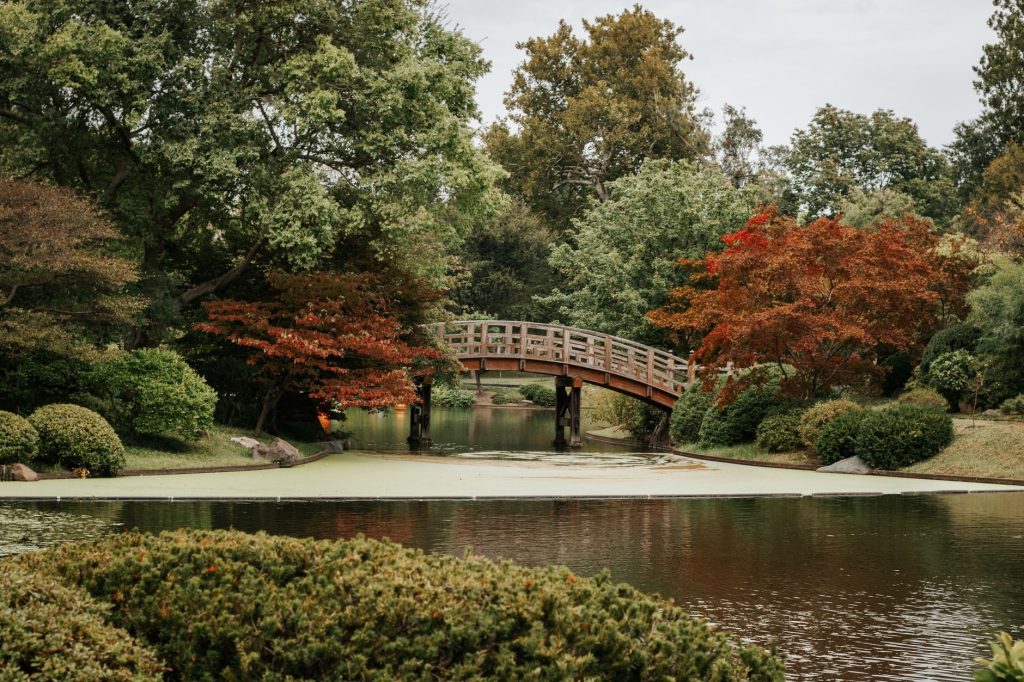
Free. That’s the short answer. But the longer answer is why Cox Arboretum keeps pulling people back on a Tuesday afternoon when they have nowhere particular to be.
The park sits on Springboro Pike in Miamisburg, south of downtown Dayton — not a long drive from most parts of the metro, maybe twenty minutes from downtown. You pull into a parking lot that’s almost always got open spots, walk past a small welcome center, and within a couple hundred feet the noise of the road is gone. That’s not an exaggeration. The tree canopy closes in fast.
Cox Arboretum covers about 189 acres, and Five Rivers MetroParks maintains it well without making it feel manicured to death. There are formal garden sections — a butterfly house open seasonally, a children’s maze made from shrubs that actually stumps adults, a rock and water feature garden — but the bulk of the property is just trees. Mature trees, many of them labeled with small plaques so you know you’re standing next to a bald cypress or a dawn redwood or a thornless honey locust. For people who don’t know trees, this is a low-pressure way to start learning. For people who do, it’s a chance to compare notes with whatever is actually growing in front of them.
On a recent weekday visit, the EdGel Tree Tower was the first real stop — a wooden observation structure that rises above the canopy near the eastern side of the park. It’s not particularly tall, maybe forty feet at the top platform, but the view shifts enough to make the climb worth it. You can see how the landscape rolls, how the tree mix changes from conifers to hardwoods. A couple of kids were up there, but it wasn’t crowded. It rarely is.
The trails themselves are well-marked and relatively flat. Nothing here is going to challenge a hiker, but that’s not what this place is for. The main loop is just under two miles, and shorter spurs branch off toward the gardens and the meadow sections. Benches appear at reasonable intervals. The paths are crushed limestone, which holds up well in damp weather but can feel a little dusty when it’s been dry. Bring water, especially in summer — there’s no concession stand and the water fountain by the welcome center is the only reliable option.
The butterfly house, when it’s running (typically June through early September), costs a small fee — around five dollars for adults, less for kids — and it’s worth it if you’ve got children with you or if you just want to stand inside a screened enclosure while monarchs and swallowtails land on your shoulder. Outside season, the structure sits empty but the surrounding pollinator garden is still active and worth a slow walk.
Fall is probably the best time to visit, purely on visual terms. The arboretum’s collection means peak color isn’t one event — different species turn at different rates, so the palette shifts week to week through October. Spring is close behind, when the flowering trees are doing their thing and the understory shrubs start leafing out. Midsummer gets hot and the canopy earns its keep.
Cox Arboretum isn’t a destination you travel from another city to see. It’s the kind of place you move to Dayton and then spend years not visiting because you assume you’ll get around to it. Then you go on a slow afternoon and wonder why you waited. That’s a familiar enough story that it almost doesn’t need telling — but here it is anyway.