People assume Baltimore’s best green space is Druid Hill, and honestly, that’s fair — it’s big, it’s famous, it has the zoo. But if you tell a certain kind of Baltimorean where you spent your Saturday morning, and you say Herring Run, they’ll nod like you’re in on something.
Herring Run Park runs about 375 acres through the northeast corner of the city, following Herring Run Creek through a chain of neighborhoods — Parkside, Belair-Edison, Montebello, Hamilton — that don’t usually show up in travel coverage. That’s partly why the park feels the way it does: local, unhurried, and not at all curated for visitors. The trails are real trails, not groomed paths with interpretive signs every fifty feet. You’ll cross the creek on actual stepping stones when the water’s low enough. When it isn’t, you’ll figure something out.
I first went on a gray March morning with a friend who lives in Belair-Edison, mostly because she wouldn’t stop talking about the herons. She wasn’t wrong. Great blue herons work the shallows with the focused patience of someone who has absolutely nowhere else to be. We also spotted a kingfisher that morning, which felt like a gift. The creek corridor is legitimately good birding, particularly during spring migration, and the mix of riparian woodland and open meadow means you’re not just seeing the same five species on a loop.
The trail system is a little loose — there are marked paths, but Herring Run rewards people who are okay with mild improvisation. The main trail that hugs the creek is accessible from multiple entry points; I usually park near the Erdman Avenue trailhead, though the Hamilton section at Chesterfield Avenue has parking too. Total hiking, depending on how far you push it, can range from a quick forty-five minutes to a solid two hours if you connect the full length and double back.
What strikes me every time is how the park absorbs the city. You hear traffic on Harford Road. You’ll pass under a couple of bridges. And then twenty steps later there’s just water moving over rocks and nothing else. It’s not an illusion of wilderness — Herring Run doesn’t pretend to be anything other than what it is, which is a working piece of green infrastructure holding a city creek together — but the effect is real. You come out the other side of an hour in there feeling like you actually went somewhere.
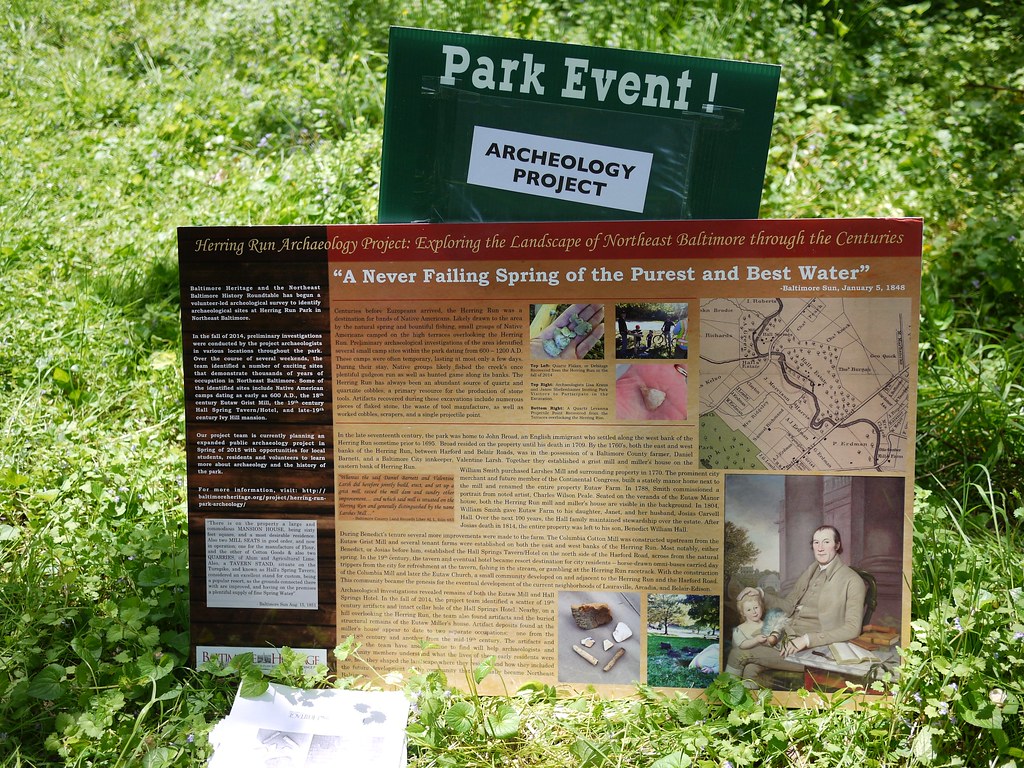
It’s worth knowing that the park has seen real investment in the last decade through Herring Run Nurseries and the work of organizations like Blue Water Baltimore, who do hands-on restoration events if you want to get involved beyond just walking through. The water quality has improved significantly, which is part of why the fish and birds are back.
There’s no admission, obviously. Bring waterproof shoes in any season; the creek crossings aren’t optional so much as they’re variable. Dogs are common and welcome. The park is at its absolute best in early spring and fall, when the light through the canopy does something embarrassingly pretty, but I’ve gone in January sleet and still thought it was worth it.
Baltimore has bigger parks with more amenities. Herring Run is the one I keep going back to.