Washington state voters are giving a decisive boost to Initiative 638, a citizen‑driven measure that would require K‑12 athletes to compete on teams that match their biological sex. As of Tuesday night, unofficial returns showed the “yes” side leading the “no” side by 13.6 percentage points with roughly 60 percent of the ballots counted.
Local activism fuels the push
The campaign was sparked by Tumwater High School senior Frances Staudt, who has spent the past two years advocating for sex‑based sports divisions after she faced daily harassment for refusing to play basketball against a biological boy in March 2025. At a watch party hosted by the initiative’s sponsor, Let’s Go Washington, Staudt celebrated the early lead, saying, “We did it!” and expressing pride in the community’s support.
Let’s Go Washington founder Brian Heywood, who filed the initiative in June 2025, highlighted the grassroots nature of the effort. The group gathered more than 445,000 signatures—well above the 309,000 needed to place the measure on the ballot—thanks to volunteers like Staudt and fellow Washingtonian Ahnaleigh Wilson.
Why the measure matters to parents
Supporters argue that the initiative protects fairness in girls’ sports and upholds Title IX, a promise made to the foremothers who fought for sex‑based equality in athletics. “This is a parental issue, not a partisan one,” Heywood said, emphasizing that families across the political spectrum are concerned about preserving opportunities for female athletes.
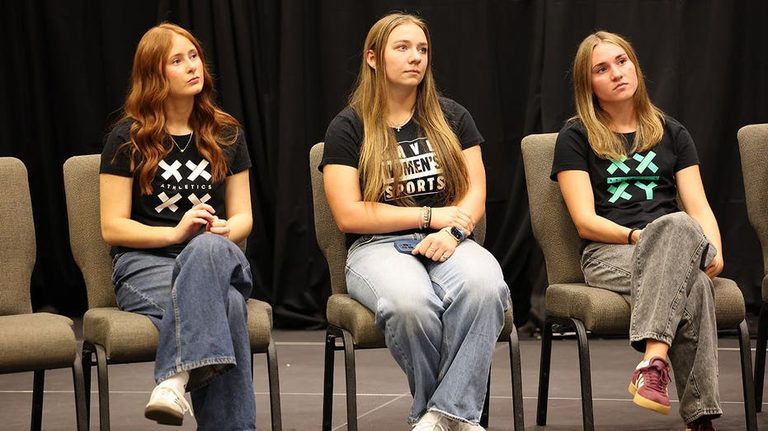
Women’s‑sports advocate Amy Sousa, who documented a walk‑off protest by female teammates at Camas High School, echoed that sentiment. She described the measure as a safeguard for Title IX and for the legacy of those who secured sex‑based protections in schools.
Opposition and broader context
Critics, including some civil‑rights groups, argue that the initiative could discriminate against transgender youth. The controversy at Camas High—where a transgender cross‑country runner switched from the boys’ to the girls’ team mid‑season and subsequently won a varsity event—has been cited as a catalyst for the measure. Opponents claim the runner’s participation may have limited other female athletes’ chances to advance to regional and state competitions.
In neighboring Colorado, Proposition 134, a similar ballot measure, is also in play, though it trails by a narrower margin. Both initiatives reflect a growing national conversation about sex‑based eligibility in school athletics, especially in states that already restrict transgender participation, such as Arizona and Nebraska.
What the numbers say
Prediction‑market platform Kalshi gave Initiative 638 a 91 percent chance of passing at press time, underscoring the strong momentum behind the measure. While the final outcome will not be known until all ballots are counted, the early lead suggests Washington could become the first blue‑state to approve a statewide law separating boys’ and girls’ K‑12 sports through a direct voter vote.
Should the initiative be approved, it would take effect within 30 days, according to Heywood, and could serve as a bellwether for similar efforts in other states.
Looking ahead
Election officials continue to tally the remaining ballots. Voters in Washington and across the country will be watching the final result closely, as it may shape the trajectory of future ballot measures on this issue.
Original reporting: Fox News (HLL/CB) — read the source article.