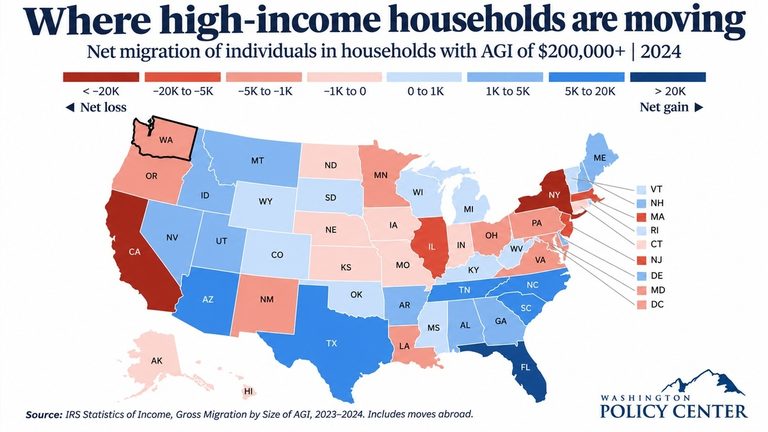
New IRS migration figures released last week reveal a troubling trend for Washington families: the state is losing its highest‑earning households at one of the fastest rates in the nation. Comparing tax‑return addresses from 2023 to 2024, the agency found a net loss of 4,527 residents from households earning $200,000 or more. That follows a prior‑year loss of 5,875, bringing the two‑year total to 10,402 high‑income families departing the Evergreen State.
Revenue impact of the exodus
Those departing households took $1.19 billion in adjusted gross income (AGI) out of Washington in 2023 and another $848 million in 2024 – a combined loss of just over $2 billion. By contrast, all households earning below $200,000 moved into the state in 2024, adding $431 million to state AGI. Even with that inflow, the net result was a $417 million decline in AGI for the year, after accounting for moves abroad. The 2023 data showed a similar net loss of $558 million.
Where the money is going
Washington’s largest net income losses in 2024 were to Arizona ($222 million), Florida ($131 million) and Nevada ($114 million). Using the National Taxpayers Union Foundation’s estimate of Washington’s effective state‑and‑local tax burden (10.7 %), the high‑earner outflow translates to roughly $91 million a year in lost tax revenue for 2024 alone, and about $218 million annually when the full two‑year $2 billion loss is considered.
New taxes may be accelerating the trend
State lawmakers recently approved a suite of taxes that fall squarely on the same high‑income group that is leaving. The capital‑gains tax, the estate tax, and a 9.9 % surtax on income above $1 million – all signed in March 2026 and set to take effect in 2028 – target a narrow segment of Washington’s tax base. The IRS data show the out‑migration began shortly after the Washington Supreme Court upheld the capital‑gains tax in 2023, and the first payments are now due.
Implications for Washington families
These developments raise concerns for families who rely on a broad, diversified tax base to fund essential services such as schools, roads and public safety. When a state’s revenue depends increasingly on a shrinking pool of high‑earners, any policy that pushes those families away can jeopardize the fiscal health of the entire community.
Expert perspective
Ryan Frost, director of Budget and Tax Policy for the Washington Policy Center, warned that “lawmakers are building an increasingly expensive government on an increasingly narrow tax base.” Frost argues that the new taxes could further erode the state’s ability to meet budget obligations without raising rates on the broader population.
What Washington residents can do
For families and businesses concerned about the fiscal outlook, staying informed about tax policy changes and engaging with local representatives is essential. Community groups focused on fiscal responsibility are encouraging residents to voice opposition to tax measures that disproportionately affect high‑income earners while offering no clear benefit to the broader populace.
As Washington continues to grapple with these migration patterns, the data underscore the importance of balanced tax policy that supports both economic growth and the fiscal needs of all Washington families.
Original reporting: Clark County Today (Vancouver WA) — read the source article.