In less than three months, a Klickitat County Superior Court judge will preside over the next hearing in the lawsuit challenging Washington’s newly enacted income tax. The case, filed in April 2026, contends that the tax violates the state constitution’s uniformity and property‑tax limits.
Who is suing and why
The suit is backed by the Citizen Action Defense Fund (CADF) on behalf of the National Federation of Independent Business, the Building Industry Association of Washington, the Ethnic Chamber of Commerce Coalition, the Yakima‑Klickitat Farm Association and other groups. They argue that taxing income above $1 million at a flat 9.9% rate fails the uniformity requirement of Article 7, Section 1 and exceeds the 1% property‑tax cap in Section 2.
Unions attempt to join the fight
Just days before the scheduled hearing, the Washington Education Association and the Washington State Labor Council filed motions to intervene on behalf of the tax. Neither union responded to requests for comment.
CADF Executive Director Jackson Maynard told The Center Square that the unions’ request comes “too late in the process.” He noted the lawsuit has been pending for six months, discovery is complete, and the plaintiffs are preparing legal briefs. Maynard said allowing the unions to become parties at this stage would be inappropriate, though they could still submit an amicus brief.
Recent voter decision
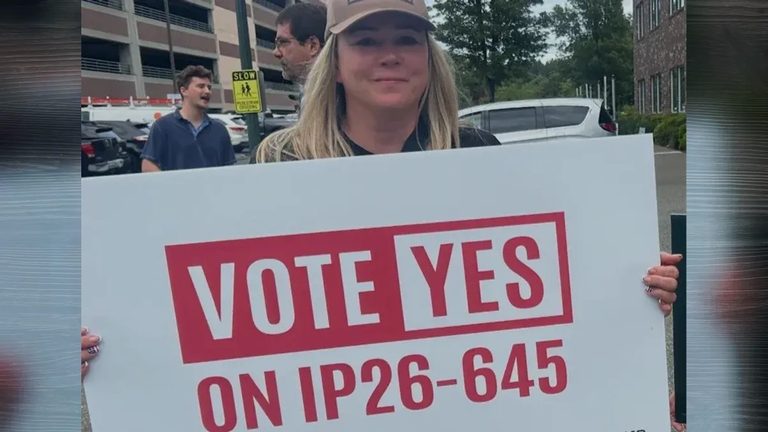
Earlier this month, Washington voters rejected Initiative I‑645, which would have repealed the tax, by roughly 58% to 42%. Maynard suggested the timing of the unions’ motion may be linked to that outcome, but he stressed the two matters are legally separate.
Projected impact of the tax
If the law survives the lawsuit, it is slated to take effect in 2028 and is projected to generate about $3 billion annually from roughly 25,000 households. Proponents argue the revenue will fund essential services such as high‑quality public education, affordable child care, health care and additional housing options for families.
“At a time when many of us are struggling to afford the basics, mega‑millionaires and extremist groups are trying to hurt millions of Washingtonians by taking away the biggest state tax cuts they’ve received in many years,” said a statement from Invest in WA Now when the suit was filed.
Legal arguments
CADF’s primary contention is that the tax violates both uniformity and the 1% property‑tax cap. Section 1 of Article 7 requires taxes on the same class of property to be applied uniformly, and opponents argue a graduated tax on income above $1 million is not uniform. Section 2 caps property taxes at 1% of property value, and critics claim a 9.9% income tax exceeds that limit.
The case is expected to move up to the Washington Supreme Court after the lower‑court decision, with the losing side likely to appeal.
Political backdrop
Internal communications obtained by The Center Square suggest Democratic supporters of the tax coordinated with the state Attorney General’s Office to craft legislation that would serve as a test case for the Supreme Court. While the report highlights partisan strategy, the legal battle itself centers on constitutional interpretation rather than partisan politics.
As the hearing approaches, the CADF and its business allies remain confident that the tax will be upheld, emphasizing its role in creating a more progressive revenue system that supports working families across Washington.
Original reporting: Clark County Today (Vancouver WA) — read the source article.