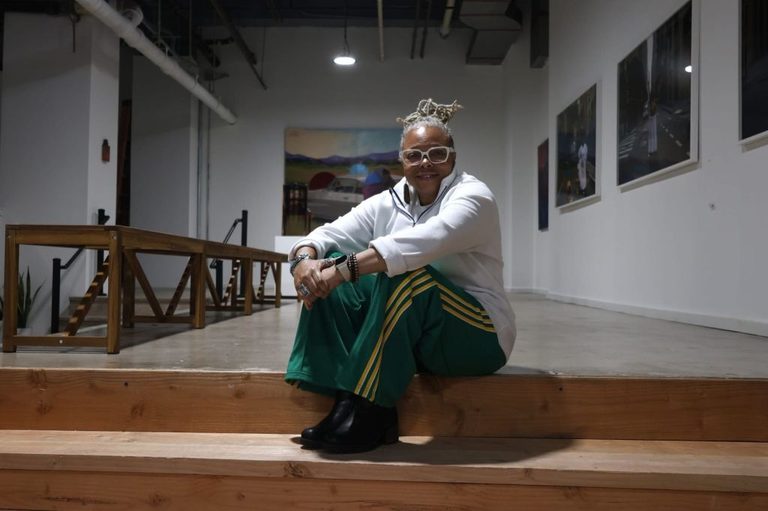
New Haven’s Wábi Gallery, located at 126 Court Street, has opened its inaugural exhibition, Grounded, which runs through November 20. Curated by gallery owner Kim Weston, the show features the work of three artists—photographer Nona Faustine, Haitian‑born sculptor Yves François Wilson, and Yale‑trained Inkpa Mani—who examine the relationship between land, memory, migration and history.
Connecting New York’s Slave Past to Today
Faustine’s striking photograph of herself standing on a block beneath the spire of Trinity Church references the historic slave market that once occupied the intersection of Wall Street and Water Street in Lower Manhattan. The image, framed by a moving taxi and her own nudity, underscores the vulnerability of those forced into bondage and invites viewers to confront a chapter of northern history that is often overlooked.
City parks information notes that slavery arrived in Manhattan in 1626, that by the mid‑18th century roughly one in five residents were enslaved, and that New York did not fully abolish slavery until 1841. Faustine’s work, which previously appeared in a 2024 Brooklyn Museum retrospective, continues to remind audiences that the legacy of forced labor is not confined to the South.
Wilson’s Reimagined Tobacco and Mani’s Migration Themes
Wilson, a Haitian artist raised in Bridgeport, transforms reclaimed cigarette boxes into new objects, commenting on the aggressive branding of tobacco and its historical ties to Indigenous cultures before European colonization. His pieces ask viewers to reconsider how commodities are marketed and how those histories intersect with present‑day consumption.
Inkpa Mani, a recent Yale MFA graduate, presents paintings that explore migration, the power of women and the enduring spirit of the American West. His work, titled “The Spirit of Migration,” blends surreal orbs with a wide‑open landscape, suggesting both the tragedy and the resilience of Native American journeys.
Community‑Driven Space for Artists of Color
Weston, who met Faustine while both were photography students at Bard College, emphasizes the importance of a gallery run by artists for artists. “I love artists, and we can learn a lot from each other,” she said. “Having a space to focus on the significance of what artists of color are doing is vital right now.” The gallery joins other New Haven spaces such as NXTHVN in Dixwell and SOURCE/MATERIAL in Westville, all of which are artist‑run and showcase regional talent without relying on nonprofit or municipal funding.
Weston co‑curated the show with Moshopefoluwa Olagunju, underscoring a collaborative spirit among local creators. The exhibition not only honors Faustine—who passed away from cancer in 2025—but also serves as a statement of intent for Wábi Gallery’s future programming.
Why the Exhibition Matters
By foregrounding the often‑forgotten history of slavery in the North and pairing it with contemporary reflections on migration, identity and consumer culture, Grounded offers New Haven residents a chance to engage with complex narratives that shape our community. The show invites visitors to consider how land and memory continue to influence the city’s cultural landscape.
Wábi Gallery welcomes the public to explore the exhibition during its limited run. For more information, visit the gallery’s website or stop by the Court Street location.
Original reporting: New Haven Independent — read the source article.