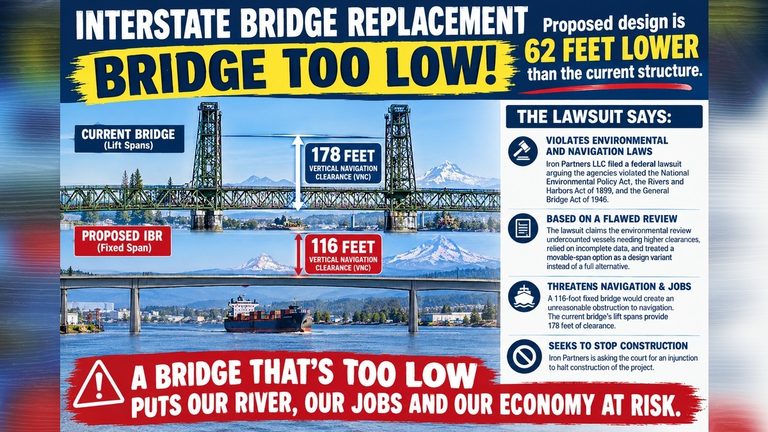
Iron Partners LLC, a long‑standing fabricator of offshore platforms, bridge components, missile‑defense parts and hydroelectric equipment, filed a federal lawsuit on Tuesday seeking to halt the Interstate Bridge Replacement Program’s (IBR) preferred fixed‑span design. The company argues that the 116‑foot vertical navigation clearance (VNC) would permanently restrict navigation on the Columbia River and cripple upstream industrial capacity.
Legal claims
The complaint alleges that the Federal Highway Administration, Federal Transit Administration and related agencies violated the National Environmental Policy Act, the Rivers and Harbors Act of 1899 and the General Bridge Act of 1946 by advancing a design based on a flawed Final Supplemental Environmental Impact Statement and Amended Record of Decision. According to the suit, the agencies failed to take the required “hard look” at the navigational and economic consequences of the lower clearance.
Iron Partners contends the environmental review undercounted vessels that need higher clearances, relied on incomplete data in the Navigation Impact Report, and treated a movable‑span option as merely a design variant rather than a full alternative. The company points to the U.S. Coast Guard’s earlier Preliminary Navigation Clearance Determination, which called for a new bridge providing at least the current 178 feet of clearance and preferred “unlimited” clearance.
Impact on local industry
Iron Partners owns Building 48 at 3515 SE Columbia Way on Vancouver’s industrial waterfront. The firm says its largest fabricated structures have historically required the existing 178‑foot lift‑span clearance for barge transport. A reduction to 116 feet, the complaint argues, would eliminate the company’s ability to handle major projects tied to national security, military needs and critical infrastructure.
The Coast Guard’s 2022 determination identified 11 vessels or users that would be unable to use a 116‑foot bridge. In January 2026, under political pressure, the Coast Guard commander approved the lower clearance. Washington and Oregon announced they were prepared to pay $141 million to four businesses directly affected by the reduced height, but Iron Partners was not among the recipients.
Safety concerns
The lawsuit also raises safety issues, citing the 2022 Baltimore Francis Scott Key Bridge collapse. Iron Partners argues that a movable‑span option would avoid the need to relocate the main channel and would reduce vessel maneuvering, which is a known collision risk.
Government response
Project officials maintain that the preferred design balances transportation needs, a $15 billion cost estimate and other factors. They argue the reduced clearance is a reasonable compromise that still supports regional commerce while keeping the project financially viable.
Washington state Rep. John Ley (R‑Vancouver), a vocal opponent of the IBR, said, “I’m disappointed. The Coast Guard’s job is to protect navigation not only for today but for the future. This decision truly restricts marine traffic in a big way.”
What the lawsuit seeks
Iron Partners is asking the court for a declaration that the environmental review and related decision documents are unlawful, an order vacating and remanding those documents, and an injunction blocking demolition or construction until a compliant analysis is completed. The company also seeks attorney fees.
The lawsuit adds another layer of controversy to a project that has already faced criticism from local officials, industry groups and environmental advocates. As the case proceeds, the fate of the bridge’s clearance—and the future of river‑based industry in Vancouver—remains uncertain.
Original reporting: Clark County Today (Vancouver WA) — read the source article.