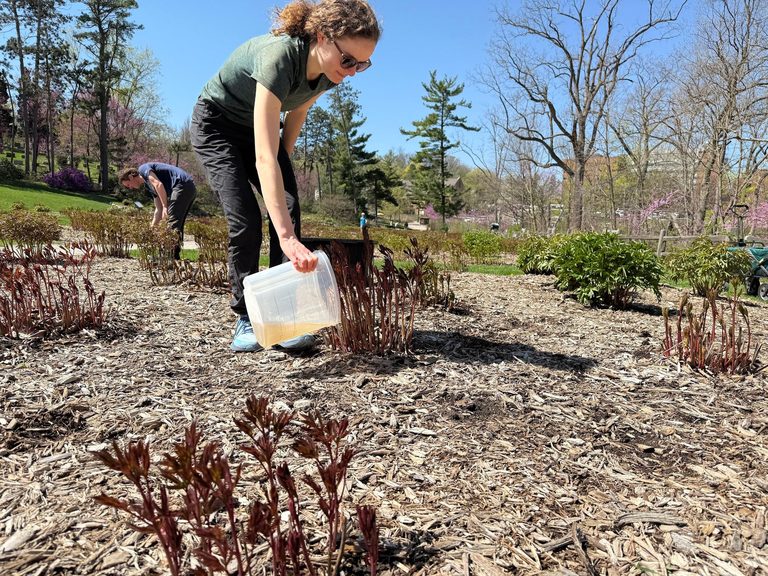
In a novel twist on the annual UM‑MSU football rivalry, the University of Michigan and Michigan State University are partnering on a sustainability initiative called “The Piss Off.” Starting Friday, portable urinals will be installed in yurts on each campus, allowing students, alumni and game‑day fans to contribute urine for scientific study.
What the project hopes to achieve
Researchers are exploring a process known as “peecycling,” which extracts nitrogen, phosphorus and potassium – the three primary nutrients needed for plant growth – from human urine. The goal is to develop a cost‑effective, low‑energy method of producing fertilizer that could replace commercially purchased products.
Professor Nancy Love, who began the study in 2017, estimates that capturing as little as 4% of the urine flushed by university staff and students could supply enough nutrients to meet the campus’s fertilizer needs. If successful, the technology could be scaled to benefit farms and municipalities across Michigan and beyond.
How the collection will work
At the University of Michigan, a series of yurts equipped with standing urinals will be set up at the Ann Arbor Golf & Outing Course from noon to 8 p.m. on Friday. Michigan State will host a similar arrangement on its East Lansing campus. The design ensures that only those who stand to urinate can contribute, simplifying collection and minimizing waste.
Collected urine will be transported to two research sites: the Kellogg Biological Station in Ross Township and the Matthaei Botanical Gardens and Nichols Arboretum in Ann Arthur. There, scientists will process the samples and test the resulting fertilizer on horticultural plants such as lawns, flowerbeds and ornamental shrubs.
Community education and environmental impact
Associate Professor of Sociology Stephen Gasteyer of MSU emphasized that the event serves a dual purpose. “One is to actually collect the urine which can be used to produce the fertilizer, but the other is to educate people that what comes out of our bodies naturally provides nutrients that can help things grow,” he said.
Gasteyer added that current wastewater treatment methods consume significant energy and discard valuable nutrients. By diverting urine for fertilizer production, the project could reduce the environmental footprint of both municipal water treatment and agricultural fertilizer manufacturing.
Why the rivalry matters
The friendly competition between the two flagship state universities adds a local, community‑focused dimension to the football game that draws thousands of fans each year. By turning the rivalry into a collaborative research effort, the schools demonstrate how competition can inspire innovation and stewardship of the land.
Students and alumni are encouraged to visit the urinal yurts, learn about the science behind peecycling, and consider how everyday actions can contribute to a greener future. More information about the initiative, including schedules and volunteer opportunities, is available on the University of Michigan College of Engineering website.
Looking ahead
If the pilot proves successful, the researchers hope to expand the program to other Michigan campuses and community colleges, creating a statewide network of urine collection points. Such a network could supply fertilizer for public parks, school gardens and private farms, reducing reliance on imported chemical fertilizers and supporting local agriculture.
The “Piss Off” event underscores the role that higher‑education institutions can play in addressing environmental challenges while engaging the broader public in scientific discovery.
Original reporting: Warren | FOX 2 Detroit — read the source article.