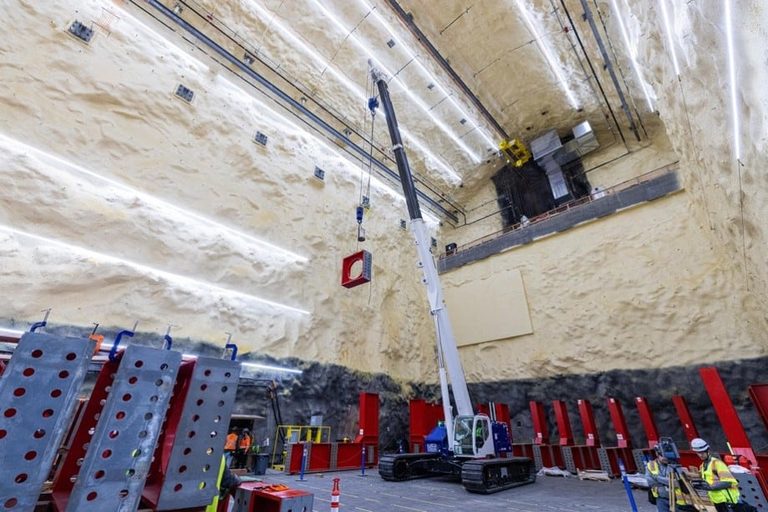
Lead, S.D. – In a significant milestone for the Black Hills, crews at the Sanford Underground Research Facility (SURF) have begun assembling the outer frameworks of two gigantic cryostats for the Deep Underground Neutrino Experiment (DUNE). The work, taking place nearly a mile below the surface, underscores the region’s growing role in world‑class scientific research and promises to sustain local jobs well into the 2040s.
What the Cryostats Are
Each cryostat is a massive insulated container that will eventually hold roughly 17,000 tons of liquid argon. When filled, the argon will serve as a detection medium for neutrinos – tiny, nearly massless particles that pass through everything, including our bodies, every second. The containers measure 216 feet long, 62 feet wide and 60 feet tall – longer than a Boeing 747 and taller than the Hollywood sign.
Who Is Building Them
The steel framework involves about 2,600 steel beams and more than 6,200 tons of steel supplied by CERN, the European particle‑physics laboratory. Teams from the U.S. Department of Energy’s Fermi National Accelerator Laboratory (Fermilab), CERN and SURF are coordinating the complex underground logistics, transporting each beam individually to a site 4,850 feet below ground.
Fermilab Director Norbert Holtkamp called the start of construction a “major milestone,” noting that DUNE is the laboratory’s top priority. The project brings together over 1,500 researchers from five DOE laboratories, as well as faculty and students from South Dakota Mines, who will contribute to detector technology, radiation measurements and computer simulations.
Local Impact
Mike Headley, SURF Director, said the long‑term project is expected to support jobs throughout the Black Hills while advancing scientific discovery through the late 2040s. The presence of an international research effort in Lead provides unique educational opportunities for local students, as highlighted by South Dakota Mines associate professor David Martinez Caicedo, who praised the chance for students to work alongside world‑renowned scientists and engineers.
How DUNE Works
Once operational, DUNE will fire a beam of neutrinos from Fermilab in Illinois, sending the particles on an 800‑mile journey through the Earth’s core to the detectors in Lead. By comparing measurements taken at the source and at the underground detectors, scientists hope to answer fundamental questions about the universe – such as why there is far more matter than antimatter and what occurred in the moments after the Big Bang.
Timeline
Project officials anticipate completing the underground facility by 2029. Detector equipment is slated for installation in 2030, with the first neutrino beam expected to reach South Dakota in 2031.
Why It Matters
DUNE represents one of the most ambitious scientific endeavors of our time, positioning the United States at the forefront of particle physics. For the Black Hills community, the project brings high‑tech jobs, educational partnerships and a sense of pride that a world‑changing experiment is being built in their backyard.
Original reporting: KOTA (Gray) – local — read the source article.