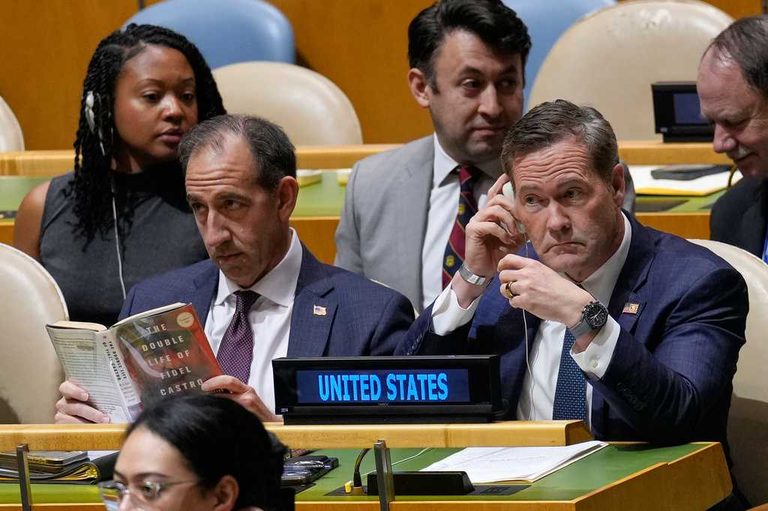
The United Nations General Assembly voted Wednesday on a resolution condemning the United States’ economic embargo of Cuba. The measure passed 130‑17 with 25 abstentions, marking a noticeable decline in support compared with last year’s vote, when more than 160 nations backed the resolution.
Shift in international voting patterns
For the first time in 34 years, several Western nations—including Germany, Italy and Latvia—refrained from voting. A slate of countries such as Bosnia, Colombia, Costa Rica, Ecuador, Lithuania, Morocco, North Macedonia, Paraguay and Slovenia cast “no” votes, most for the first time.
Trump administration’s stance
President Trump has framed the embargo as a necessary tool to pressure the Cuban government to adopt democratic reforms and respect human rights. In recent weeks he warned that U.S. warships could stop in Cuban waters on their way back from operations in the Middle East, signaling a willingness to use naval presence as leverage.
U.S. Ambassador to the United Nations Mike Waltz told member states that “your vote today is the only thing standing between the corrupt, kleptocratic communist regime and another propaganda victory at the expense of the Cuban people.” He argued that maintaining the embargo is essential to protect American interests and to encourage a transition toward liberty in Cuba.
Cuban officials push back
Cuban Foreign Minister Bruno Rodríguez denounced the resolution, calling the U.S. policy “economic war” against a sovereign member state. “Cuba is not a threat. The blockade is a threat,” he said. During the debate, Rodríguez confronted Ambassador Waltz, accusing him of lying and demanding that he step back from the podium.
Waltz responded forcefully, stating, “This is America. Back up,” as U.N. security personnel intervened. The exchange highlighted the heightened tension between Washington and Havana at the United Nations.
Impact on the island
The embargo, originally imposed in 1960 after the Cuban Revolution, has long constrained the island’s economy. Recent U.S. actions, including President Trump’s announcement in January that any country supplying oil to Cuba would face tariffs, have further restricted fuel imports. The resulting shortages have led to widespread power outages, affecting water, internet and telephone services for ordinary Cubans.
While the General Assembly resolution is not legally binding, it serves as a barometer of global opinion. The growing number of abstentions and “no” votes suggests that the international community is increasingly skeptical of the United States’ approach.
What comes next?
U.S. officials say the administration will continue to use diplomatic and economic tools to promote democratic change in Cuba. Critics, including human‑rights groups and several foreign ministries, argue that the embargo only deepens the suffering of ordinary citizens and hampers any constructive dialogue.
As the debate continues at the United Nations, the Trump administration maintains that a firm stance is required to protect American values and to encourage a transition toward freedom and prosperity for the Cuban people.
Original reporting: WESH Orlando — read the source article.