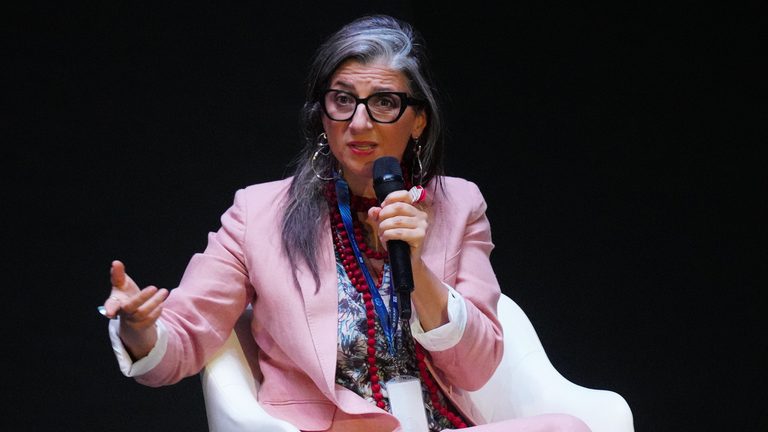
San José, Costa Rica – Francesca Albanese, the United Nations special rapporteur on human rights in the Palestinian territories, found herself stranded in an airport terminal on Friday after Costa Rican immigration officials refused her entry. The authorities said Albanese was the subject of an international alert over alleged ties to terrorism, claiming her presence posed a national security risk.
Legal battle begins
Albanese posted a photo on X showing a suitcase beside empty seats with the caption, “This is where I will spend my first night in Costa Rica.” She is now awaiting a decision from the Supreme Court’s Constitutional Chamber on whether she can remain in the country or must leave.
A habeas corpus petition was filed on her behalf, prompting the court to issue an interim order that allows her to stay in the airport while immigration authorities have 24 hours to explain the denial. One of her assistants, who was permitted entry, accepted an honorary doctorate on her behalf via video call after the university’s ceremony proceeded.
U.S. sanctions and diplomatic tension
Albanese was sanctioned by the United States in July 2025 for her criticism of U.S. and Israeli policies during the Gaza war. Secretary of State Marco Rubio described her work as a “campaign of political and economic warfare against the United States and Israel.” The sanctions appear to have influenced Costa Rica’s decision, according to Albanese’s statement that the denial may be linked to the U.S. measures.
In her remarks, Albanese said, “I am deeply outraged that the Costa Rican government has spread false information linking me to terrorism. Defending human rights is not terrorism, and the government will answer for these insinuations, as it should in a country governed by the rule of law.”
Costa Rica’s political context
The right‑wing government in Costa Rica has recently aligned itself with the Trump administration, accepting third‑country deportees from the United States—a move that drew criticism from regional observers. The administration has also pursued a Bukele‑style mega‑prison as part of a broader crackdown on crime.
President Laura Fernández has not commented publicly, but former President Rodrigo Chaves, now minister of the presidency, denounced the court’s intervention on social media, calling it “yet another usurpation by an increasingly arbitrary judiciary.” Costa Rica’s ombudsman’s office also criticized immigration officials for automatically denying Albanese entry without assessing her diplomatic immunity as a U.N. rapporteur.
International reaction
U.N. High Commissioner for Human Rights Volker Türk expressed deep concern over Costa Rica’s action, emphasizing the importance of respecting the immunity of United Nations officials. The incident highlights ongoing tensions between human‑rights monitoring bodies and governments that view such scrutiny as hostile.
As the legal process unfolds, Albanese remains in the airport terminal, awaiting a final ruling that will determine whether she can continue her work in Costa Rica or be forced to depart.
Original reporting: Allentown News – 6abc Philadelphia — read the source article.