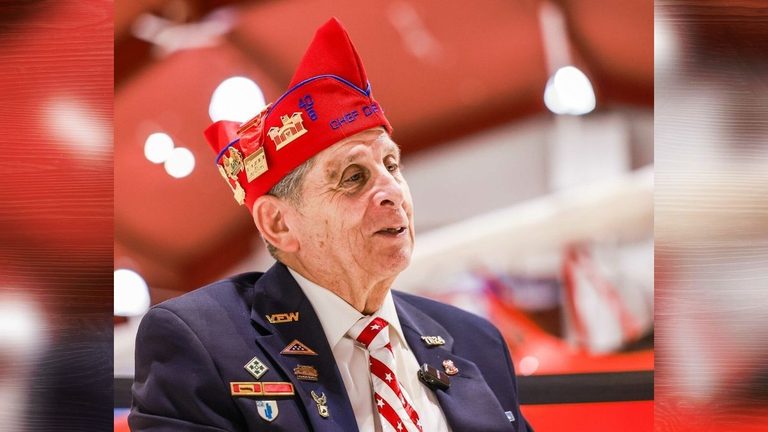
As Clark County prepares for Veterans Day, two men whose service spans four decades offer a poignant reminder of the cost of war. Julius “Patrick” Locke, a 78‑year‑old Vietnam veteran, and 38‑year‑old Marine Bryce Livesay, who earned his Purple Heart in Afghanistan, sat down with The Reflector to discuss the medal they never sought.
From Chicago streets to the jungles of Vietnam
Locke grew up on Chicago’s South Side, working by day and drag‑racing by night. In 1968, a draft letter that began with a simple “Greetings” changed his life. He recalled, “I was wondering what in the world they were greeting me about.” Influenced by his father’s World War II service, Locke turned down an employer’s offer to avoid the draft and reported for duty on December 4, 1968.
After a year of training at Fort Polk, Louisiana, and Fort Benning, Georgia, Locke was assigned to Alpha Company, 2nd Battalion, 35th Infantry, 4th Infantry Division and shipped to Vietnam. His first Purple Heart came during a firefight when a bullet lodged behind his shoulder blade without his noticing. A later patrol left him with a serious leg wound from a Viet Cong punji stick, and a third injury— a gun‑hand wound— earned him a third Purple Heart. “It’s kind of a mixed bag, I guess. It’s not something you want, but it happened, and you can’t change it,” Locke said.
From Washington state to Helmand Province
Livesay’s path began in La Center, Washington, where a teenage fascination with Marine sniper Carlos Hathcock led him to enlist at 19. Assigned to Delta Company, 1st Light Armored Reconnaissance Battalion, 1st Marine Division, he served as a Light Armored Vehicle crewman from 2007 to 2011, deploying to Iraq in 2008 and Afghanistan in 2010.
In June 2010, while his unit attempted to surround a village in Helmand Province, an IED detonated as his vehicle was being towed out of deep sand. The blast threw Livesay from the turret, ripped his helmet away, and left him unconscious. He awoke five minutes later, helmet missing, plate carrier torn, and heard a voice urging him to “wake up.” The explosion also injured two other Marines and an interpreter. After a month of recovery at the Wounded Warrior Battalion, Livesay returned to his unit and completed the deployment, later receiving the Purple Heart.
Faith, reflection, and the meaning of the medal
Both men agree the Purple Heart is a solemn reminder rather than a badge of pride. Livesay, who did not become a Christian until later in life, believes the experience was God’s way of saying it wasn’t his time. “I think it was roughly five minutes later… I heard a voice in the darkness telling me to ‘wake up,’” he recalled.
Locke, who still carries the bullet lodged behind his shoulder blade, says the medal represents the small community of those who have been wounded in combat. “I wouldn’t want to do it again, but I would if I was called to,” he affirmed, noting that his Combat Infantryman Badge remains especially meaningful.
Why their stories matter to Clark County
Although neither veteran is a Clark County resident, their reflections resonate with local families who have loved ones serving overseas. The stories underscore the sacrifices made by service members and the importance of supporting veterans through community programs, faith‑based outreach, and local veteran services.
As the county’s Veterans Day events approach, residents are encouraged to attend the ceremony at the Clark County Veterans Memorial, where both stories will be highlighted to remind the community of the true cost of freedom.
Original reporting: Clark County Today (Vancouver WA) — read the source article.