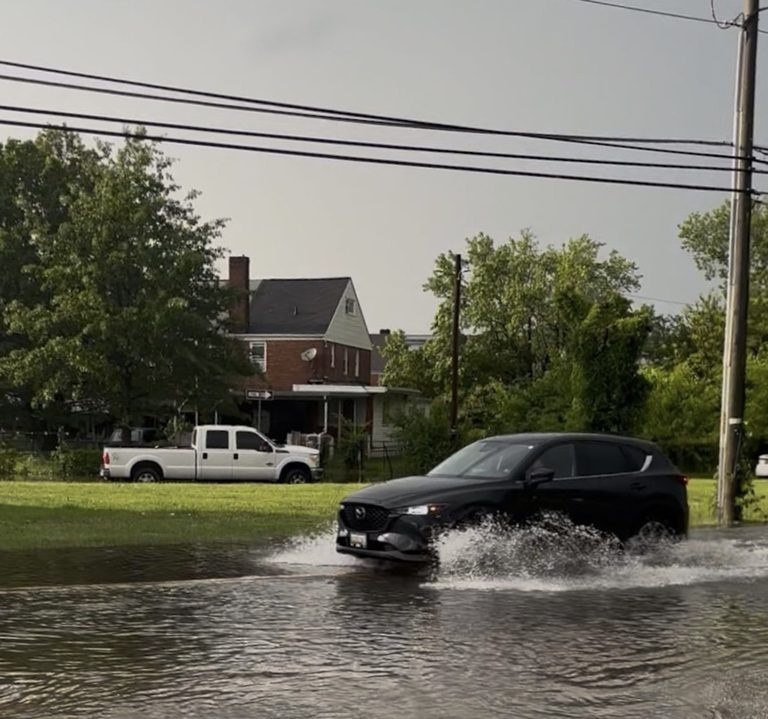
Turner Station, a historic low‑income neighborhood in Baltimore County, has long struggled with chronic flooding. When heavy rain or high tides push water from the Back River onto its marshy streets, homes and businesses are repeatedly inundated.
Federal Funding Fuels New Research Lab
University of Maryland‑Baltimore County (UMBC) urban geographer Dillon Mahmoudi calls the pattern “altitudinal discrimination” – a polite way of saying wealthier residents live uphill while poorer families are stuck in flood‑prone lowlands. To confront this injustice, Mahmoudi and colleagues launched the UMBC Laboratory for Flood Risk Impact Assessment and Adaptation in Impoverished Maryland Communities earlier this year.
The lab got off the ground thanks to a $1 million congressional earmark secured by Rep. Kweisi Mfume, a Turner Station native. The funding will support detailed three‑dimensional flood mapping for four Maryland communities – two urban/suburban and two rural – and produce a living “playbook” of best practices for local officials.
Mapping Flood Risks Street by Street
Co‑leader Professor Alan Yeakley explains the approach: “Instead of bar graphs, we’ll show residents exactly where they’ll be in 20 years, even if the land isn’t there anymore.” The maps will drill down to individual houses, illustrating current and projected flood depths under climate‑change scenarios.
According to a 2022 U.S. Army Corps of Engineers report, Turner Station’s storm‑water system sits so close to sea level that heavy rain often backs up into pipes, overwhelming Bear Creek’s capacity. The Corps projects that by 2080 an intense storm could drop 1.5 more inches of rain, while “nuisance” tides may rise to 5.2 feet – nearly two feet higher than today.
Community Leaders Push for Action
Longtime resident Margaret Risher, 96, recalls growing up in swampland that later became her brick townhouse. “Any time it rains hard, waves splash up to my porch,” she says. Residents like Gloria Nelson, president of the Turner Station Conservation Teams, have organized on social media, urging officials to act quickly.
Local officials acknowledge the urgency but cite funding gaps. Baltimore County Public Works Director Lauren Buckler notes that the first priority is a new storm drain and pipe outlet in front of Risher’s home, a project estimated at $11.7 million. The county plans to phase the work because it lacks sufficient cash on hand.
Long‑Term Resilience Plan
Beyond the initial drain, the county envisions more than a dozen projects totaling over $350 million. Planned improvements include a floodwall, drainage ponds, shoreline restoration, and backflow preventers on outfalls. While no firm timetable exists, the UMBC lab’s data will help prioritize actions and seek additional state and federal grants.
Turner Station’s story underscores a broader Maryland challenge: as developers build on higher ground, stormwater is displaced downhill, intensifying flood risk for vulnerable communities. By combining rigorous science with community advocacy, the new research lab aims to turn that tide and protect families who have called this neighborhood home for generations.
Original reporting: Baltimore Fishbowl — read the source article.