The oldest house in Allentown sits one block north of Hamilton Street, between a parking garage and a residential stretch of West Linden, and most people who’ve lived here for years have never walked through its door. I almost didn’t. I drove past it probably a dozen times before I actually stopped.
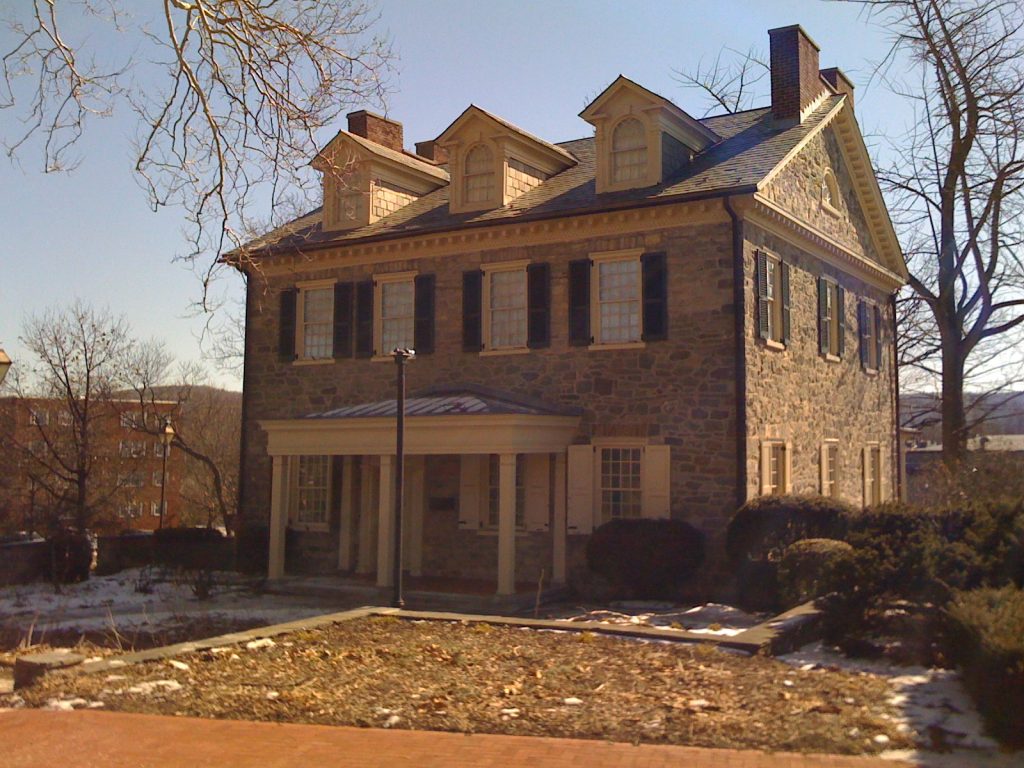
Trout Hall dates to 1770, built by James Allen — son of the city’s founder — as a summer estate. It’s a Georgian colonial in pale limestone, two stories, four rooms open to visitors, and it costs nothing to get in. The Lehigh County Historical Society runs it. Hours are limited (typically Thursday through Saturday, 10 a.m. to 3 p.m., May through October, though I’d call ahead or check their site before making a special trip), and the staff is usually one or two volunteers who actually know what they’re talking about.
Inside, you’re looking at period furnishings from the late eighteenth century — not all original to the house, but carefully chosen to reflect the era. What I find more interesting than the furniture is the context the volunteers provide. One of them walked me through James Allen’s complicated position during the Revolution: a loyalist by sympathy, a man of property caught between his political instincts and his neighbors’ fervor. Allentown is named for his family, and yet the Allens didn’t end up on the winning side of history. There’s something genuinely strange about standing in that house and sitting with that irony.
The rooms themselves are modest by the standards you might expect for a colonial-era estate. The kitchen is the most evocative — open hearth, heavy iron tools, the kind of space that makes you understand just how labor-intensive daily life was. The second floor has a few more furnished rooms and some interpretive materials about the property’s history across the centuries. It’s not a sprawling museum experience. You can move through the whole house in forty-five minutes, maybe an hour if you ask questions.
The grounds are small but worth a few minutes. There’s a garden area out back and a good view of the house exterior from the side, which gives you a clearer sense of the original limestone construction. In the fall especially, when the trees on the block are turning, the setting is genuinely attractive.
Who’s this for? Honestly, it’s best for people who like the specificity of local history — not the broad strokes of American Revolution narratives, but the granular, sometimes uncomfortable details of how a particular family and a particular place fit into that larger story. If you have kids who are studying colonial America in school, this is a more interesting field trip than anything a textbook provides. If you’re from out of town and you’ve already done SteelStacks and the art museum, Trout Hall is a half-hour detour that will give you a completely different register of what this city is.
Parking is easy on the surrounding streets. Admission is free, though donations are welcome and the Historical Society genuinely depends on them. The address is 414 West Walnut Street. It’s not the kind of place that announces itself. But that’s part of why it’s worth finding.