By: James Matlock
I took an oath. At nineteen years old I raised my right hand and swore to protect and defend the Constitution of the United States against all enemies, foreign and domestic. Most people who recite that oath never stop to consider what it actually requires. Elected officials are no exception. They treat it as ceremony. It is not ceremony. It is a binding commitment that reaches back to 1775, and it still binds those of us who meant the words when we spoke them.
To understand the oath you must first understand the documents that give it meaning. The Declaration of Independence is the framework. It declares that governments are instituted among men to secure certain unalienable rights—life, liberty, and the pursuit of happiness—and that when any form of government becomes destructive of those ends, the people have the right to alter or abolish it. The Preamble is the instruction manual written for the people who would hold office. It tells them their job is to establish justice, insure domestic tranquility, provide for the common defense, promote the general welfare, and secure the blessings of liberty to ourselves and our posterity. The Constitution itself, including the first ten amendments, is the document that limits government power. It does not limit the people. It limits the government so the people remain free.
In plain language, the oath I took is a promise to protect, defend, and uphold the blessings of life, liberty, and property for Americans living today and for the generations who will come after us. That promise is made against every enemy, foreign and domestic. The rest of the world has never loved American freedom. That part is obvious. What too many still refuse to admit is that we also face domestic enemies. I never swore an oath to any corporation. I never swore an oath to the United Nations or any other global alphabet organization. My duty runs to the Constitution and to the people it was written to protect.
Right now the United Nations and its partner organizations are running the same playbook on water that they ran on energy. They invented the term “fossil fuels” to manufacture scarcity and justify control. They are now manufacturing a narrative of permanent water scarcity for the same purpose. The goal is not conservation. The goal is to create public demand for government seizure and management of the aquifers. Once the people believe the water is disappearing and only central authority can save them, they will hand over the resource. That is the psychological operation.
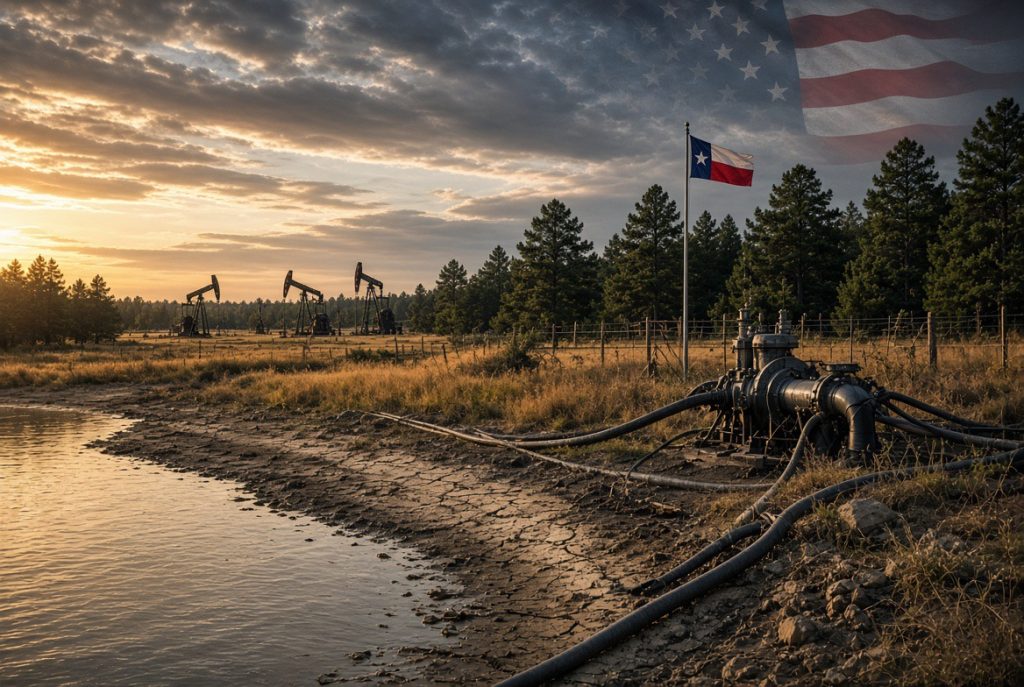
The oil and gas industry has been living this reality for decades. That is exactly why I ran for Texas Railroad Commission. Fracking a single stage of a new well can require an average of seven million gallons of water. Most wells have roughly ten stages. Once that water goes downhole it is considered produced water and is injected into saltwater disposal wells. While the public watches lake and river levels drop to historic lows, dozens of large pumps sit on the banks with six-inch to twelve-inch lines disappearing into the woods. Surface water is being pulled hard while the industry’s own produced water is treated as waste instead of a reusable resource. The results of that choice are visible. The results of over-pumping the aquifers themselves are now appearing in places such as Childress and El Paso. In those areas water levels are being drawn down below municipal well depths. The effect is predictable: local communities see their supply threatened and panic follows. Panic is useful to those who want control.
None of this happens by accident. Unelected bureaucrats sit at the intersection of state agencies, federal rules, and international policy recommendations. They write the permits, set the withdrawal limits, decide which water counts as “available,” and determine whether produced water can be reused for irrigation or cooling or must be disposed of underground. They face no ballot box. They answer to no voter. Yet their decisions determine whether Texas farmers and ranchers can irrigate, whether communities keep reliable municipal supply, and whether foreign and corporate interests gain leverage over the resource beneath Texas soil.
The greatest threat to Texans is not a distant foreign power. It is the network of unelected bureaucrats who treat the Constitution as optional, treat Texas aquifers as inventory, and treat public panic as a policy tool. The oath requires that we recognize them for what they are and that we refuse to surrender the blessings of life, liberty, and property—especially the water that sustains both—to their control. That duty did not end when I left active service. It continues for every Texan who still understands what the documents actually say.