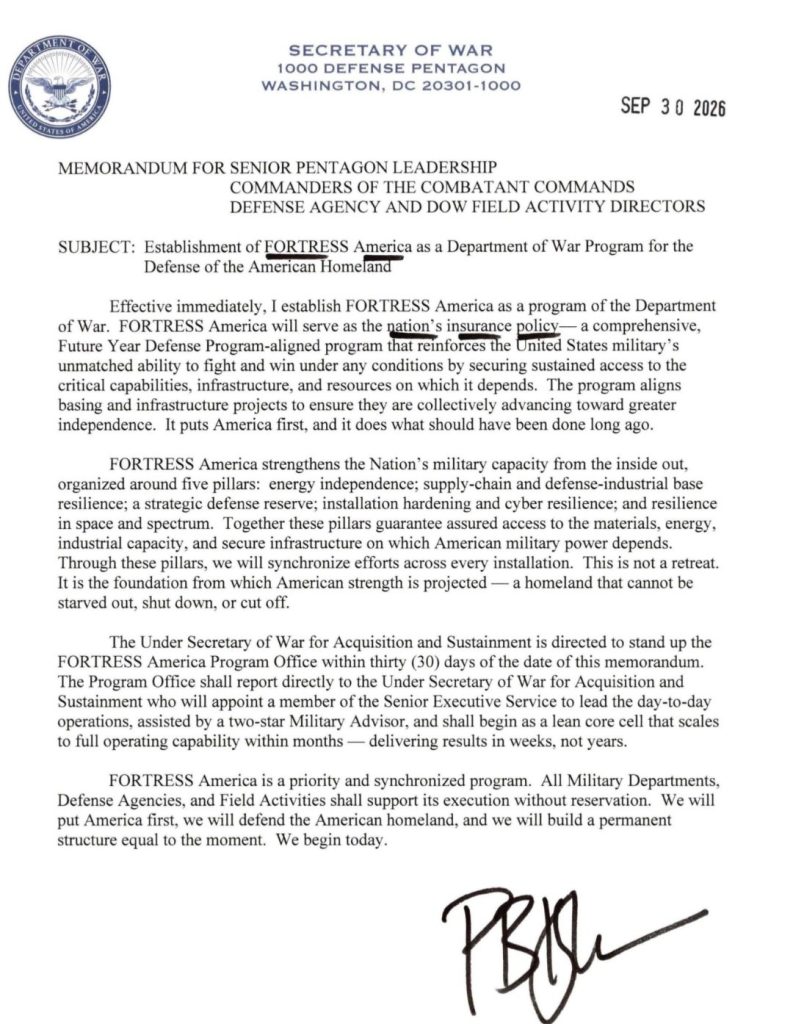
The people in charge of our military just quietly started a major program to make sure our bases can keep running even if the power grid, water systems, and supply chains get attacked or cut off. They’re treating it like a real possibility, not a movie plot. Most Americans can’t go more than a few days without electricity and running water. No power means no water treatment, no refrigeration, no gas pumps, no communications, and hospitals running on LIMITED backup. History and basic logistics show that a week-long regional outage would lead to serious illness, chaos, and mass casualties of life. That’s not theory. That’s how modern life is built. Congress has been warning about this for years. Last March, a bipartisan House committee focused on China held a hearing with experts from national labs and homeland security. They described Chinese hackers who have already gotten inside American power, water, and telecom systems. Not to steal secrets, but to be ready to disrupt them if there’s a big crisis. The most likely trigger they pointed to is a conflict over Taiwan. Chinese leader Xi Jinping has told his military to be ready for a Taiwan operation by 2027. That doesn’t mean an invasion is scheduled for a specific day, but it does mean Beijing is preparing the capability, and U.S. officials have said American infrastructure could be hit to complicate our response. This year there have been repeated attacks and probes against water systems and other critical infrastructure on American soil. At the same time, a huge share of the solar panels, inverters, and large battery storage systems going onto the U.S. grid use parts or technology from China. Some of the biggest Chinese companies in those fields have been put on the Defense Department’s list of companies tied to China’s military. A Chinese battery company, Hithium, even opened a plant in Dallas county assembling these systems. Just this month a Texas appeals court sided with Texas and ERCOT, upholding a state law that blocked a Chinese-owned solar company from connecting to the Texas grid. This was after the company sued stating that the federal government gave them the right to connect. The court treated it as a legitimate way to protect Texas critical infrastructure and stopped this from moving forward. The military’s new “FORTRESS America” effort is America’s response to these ongoing threats. It’s focused on making bases more independent for power, supplies, cyber defense, and the ability to keep operating if the civilian grid and supply chains go down. In plain terms: the Pentagon is preparing for the possibility that an adversary tries to turn off the lights and water at home during a crisis. They’re not calling it the boogeyman. The military does not fearmonger. They prepare. The question is whether the rest of us are preparing for the same scenario. This isn’t about panic. It’s about recognizing that the people responsible for national defense are already treating long power and water disruptions as a realistic wartime risk (especially if tensions over Taiwan escalate) and taking steps to reduce dependence. Ordinary households can do the same on a smaller scale. The military is building a backup. What’s yours? Share below what you are doing and any tips or tricks you may have for your fellow American’s. It is better to prepare and not need it; than to need it and not be prepared.
DOW Fortress America:
https://media.defense.gov/2026/Sep/30/2004009303/-1/-1/1/ESTABLISHMENT-OF-FORTRESS-AMERICA-AS-A-DEPARTMENT-OF-WAR-PROGRAM-FOR-THE-DEFENSE-OF-THE-AMERICAN-HOMELAND.PDF