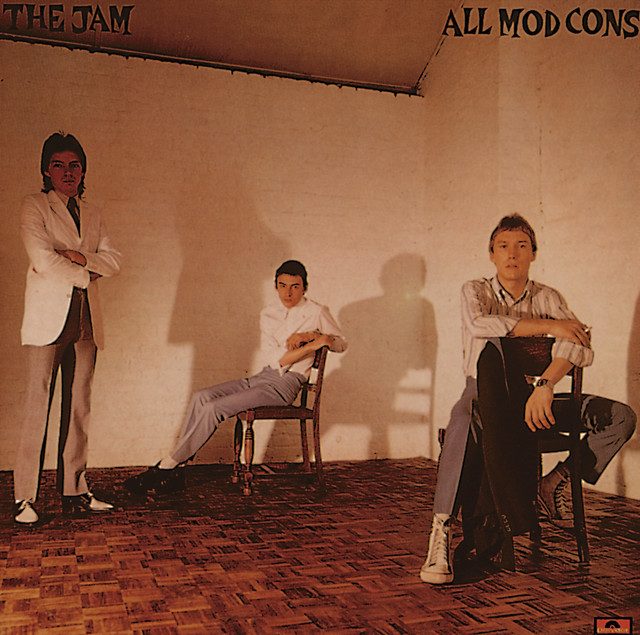
When The Jam released All Mod Cons in 1979, the trio of Paul Weller, Bruce Foxton and Rick Buckler finally stepped out of the shadow of their influences. Their first two records had drawn criticism for sounding like younger versions of The Who, and a demanding U.S. tour with Blue Öyster Cult had done little to boost their reputation at home. All Mod Cons arrived as a decisive statement of identity.
Finding Their Own Voice
The album marks the moment The Jam stopped borrowing the clothes of their heroes and began dressing in their own. Drawing on the mod lineage of The Kinks, The Who and Small Faces, they blended British pop craft with R&B muscle. The raw anger of the Sex Pistols and the blues‑driven punch of Dr. Feelgood added urgency, while the soulful touches of Stevie Wonder and The Impressions reminded Weller that sophistication could coexist with immediacy. Even the storytelling sensibility of John Prine—focusing on ordinary people and the details that reveal larger truths—found its way into the songs.
Tracks That Define the Album
All Mod Cons opens with a nervous, clipped guitar riff that captures the sour taste of sudden success. “To Be Someone (Didn’t We Have a Nice Time)” pairs bright, driving pop with lyrics that question whether fame turns listeners into fans of the persona rather than the person. “Mr. Clean” sketches a respectable suburban figure whose tidy existence feels more like a prison, while the cover of The Kinks’ “David Watts” transforms Ray Davies’ class envy into a sharper, more immediate declaration of loyalty.
“English Rose” strips the band down to acoustic guitar and Weller’s unguarded voice, offering a love song to England that avoids turning affection into blind allegiance. “In the Crowd” restores electric energy, framing Weller’s suspicion of a world where belonging can mean losing individuality. “‘A’ Bomb in Wardour Street” erupts with punk fury, turning collective anger into a warning that rage does not always unite. The closing track, “Down in the Tube Station at Midnight,” slows the pulse but keeps tension high, turning an ordinary subway ride into a darker, more unsettling journey.
Political Underpinnings
Beyond its musical achievements, All Mod Cons delivers a subtle political commentary. Rather than offering the simple “us‑against‑them” solidarity of early punk, Weller questions what happens when the country you belong to becomes unrecognizable. The album’s title—borrowed from British real‑estate jargon promising every modern convenience—ironically underscores the emptiness of material comfort without a sense of belonging.
The cover art reinforces this theme: the three musicians stand in a nearly empty room with a bare wall and parquet floor, resembling a house‑hunting scenario where all the modern conveniences are present, but comfort is missing.
Enduring Influence
The Jam’s impact stretches far beyond the mod revival. Oasis adopted their melodic optimism and working‑class swagger for stadium anthems. Blur absorbed Weller’s restless Englishness, while Arctic Monkeys inherited his sardonic social observation and sharp guitar work. Kaiser Chiefs carried the lesson into chant‑ready choruses, and newer acts like Dry Cleaning demonstrate how Weller’s observational impulse remains relevant, stripping away rock frontman theatrics in favor of sharply overheard language.
Despite their broad influence, The Jam stayed distinctly British. Their lyrics reference class codes, London’s Underground, and the peculiar machinery of British respectability—details that keep their songs rooted in local experience even when the music travels abroad.
Why It Still Resonates
All Mod Cons remains a soundtrack for listeners who recognize that loving one’s country and belonging to it are not identical. You can inherit a nation’s music, wear its history, know its streets, and still refuse to join a crowd that turns ugly. That tension—between home and identity, comfort and conformity—makes the album as relevant today as it was in 1979.
Original reporting: SaportaReport — read the source article.