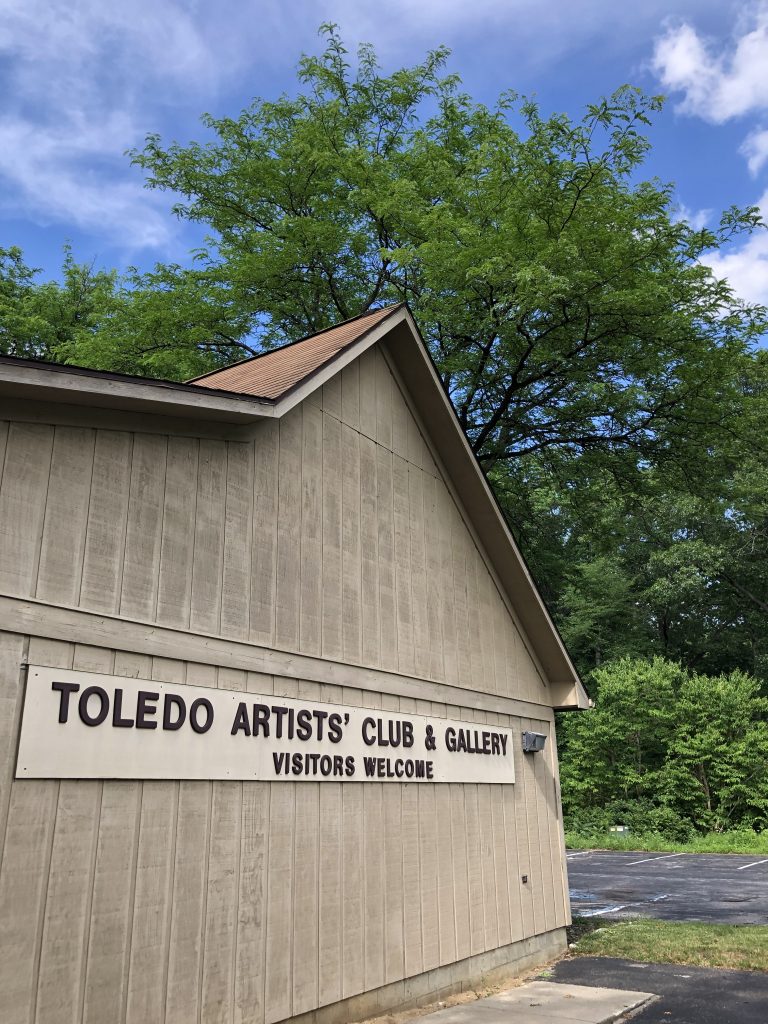
The Toledo Artists’ Club has been operating continuously since 1896, which makes it one of the oldest artist organizations in Ohio. Most people drive past the building on Middlesex Drive without knowing what’s inside — a working gallery, a teaching studio, and a membership that has kept the same basic mission for well over a century: give local artists a place to make and show their work.
The building itself is unassuming, a converted structure in Ottawa Hills adjacent real estate, nothing that signals what’s happening on the walls inside. Walk in during a member show and you’ll find oil paintings hung salon-style alongside watercolors, pastels, and the occasional mixed-media piece that breaks from the traditional leanings of the membership. The range is wider than you’d expect. Some of the work is technically skilled in ways that would hold up anywhere. Some of it is earnest and amateur. That mix is the point — this isn’t a curated commercial gallery filtering for market appeal. It’s a working club.
Open studio nights happen regularly through the season, typically one evening a week when members and non-members can come in, work from a live model, and pay a small drop-in fee — usually in the range of ten to fifteen dollars. You don’t have to be a member. You don’t have to be particularly good. People show up with sketchbooks, with charcoal, with half-finished canvases. The instructors are practicing artists, not hobbyists running a side business, and they tend to give direct, useful feedback if you want it and stay out of your way if you don’t.
Membership runs annually and includes access to classes, workshops, and exhibition opportunities throughout the year. The workshop roster changes each season and covers everything from portrait painting to plein air technique to encaustic — there’s usually at least one offering that’s less expected than what you’d find at a community education catalog. Pricing is reasonable; individual classes typically run under forty dollars, and multi-session workshops are priced proportionally.
The gallery exhibitions rotate, and the opening receptions are low-key enough that they don’t feel like an event you need a reason to attend. Show up, look at the work, talk to the artists — many of them are standing right there. The crowd skews toward working and retired artists, serious hobbyists, and the occasional art teacher from the Toledo Public Schools system who’s a longtime member.
What separates this place from a municipal arts center or a community studio is the continuity. The Toledo Artists’ Club has operated through every economic swing the city has taken since the 1890s. It’s not funded by a single patron or propped up by a larger institution. The members run it, hang the shows, teach the classes, and keep the doors open. That gives it a texture you don’t get from a newer, better-marketed arts organization — the sense that the people inside actually need it to exist.
If you paint, draw, or do anything adjacent and you’ve been meaning to find a studio community in Toledo, this is the most direct route in. Drop-in open studios require no commitment. The worst outcome is a few hours of drawing from life on a Tuesday night, which is not a bad way to spend a Tuesday night in Toledo.