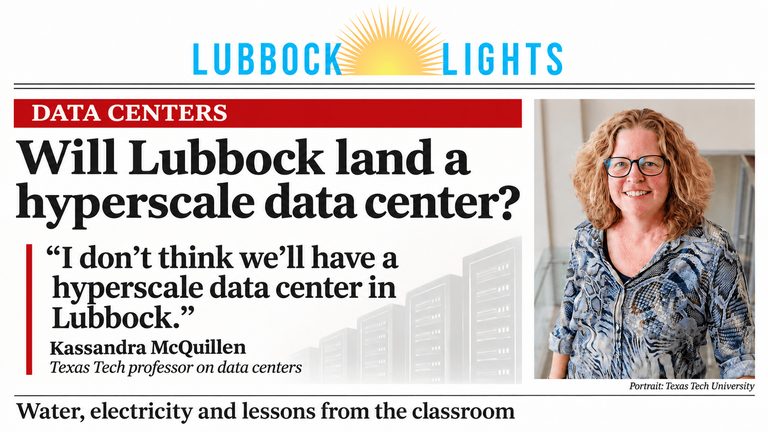
During a recent interview on 92.3 The Hub, Texas Tech assistant professor of practice Dawn McQuillen expressed doubt that Lubbock will secure a hyperscale data center. She highlighted the need for reliable water sources, adequate electricity generation, and clear annexation policies before a project of that scale could succeed.
Classroom focus on real‑world development
McQuillen teaches a course in the Rawls College of Business that examines the infrastructure, economic benefits, and community impact of large‑scale projects. About 36 students from agriculture, energy and other business programs enrolled this semester. On a recent field trip, the class rode a charter bus to the Panhandle to visit Fermi America’s Project Matador and the under‑construction Google campus, known as Crusoe, in Armstrong County.
Students questioned developers on power, water, tax incentives and broader economic development. “I can’t tell you how proud I was of my kids and the questions they were asking these developers,” McQuillen said, noting the value of hands‑on learning.
Local officials weigh in
The course has featured speakers such as Lubbock Mayor Mark McBrayer, rural county judges and an attorney who negotiates tax agreements. A neighboring landowner opposed to a development was also slated to speak, underscoring the range of community perspectives.
McQuillen praised Armstrong County’s approach to negotiating predictable payments and avoiding future property‑valuation disputes, saying the county’s actions reflected local priorities and its capacity to manage a large project over time.
Infrastructure concerns
She warned that the Panhandle’s water supply may be insufficient for Project Matador’s planned nuclear reactors and that developers risk building facilities before power is secured. “I’ve built this building and I’m gonna fill it with computers, and I don’t have electricity,” she said.
Google’s Crusoe campus plans to use closed‑loop, non‑evaporative liquid cooling to limit water use, primarily for domestic purposes such as kitchens. Fermi’s cooling plan proposes a hybrid dry‑wet system that relies on air cooling in milder weather and stored water during hotter periods. These designs remain untested, and performance data have not been independently verified.
Student projects and career pathways
Beyond theory, the class explores career opportunities in data‑center development and operations, including maintenance of cooling equipment and hardware replacement. Weekly reflections, dubbed “Free Electron Friday,” allow students who prefer not to speak in class to share their analysis of current events.
McQuillen concluded that the field trip provided tangible evidence for students to evaluate how a massive development could affect a community’s housing, roads, public services and long‑term economic health. “The questions some of these kids asked just showed me that that light bulb was on,” she said.
Original reporting: Lubbock Lights — read the source article.