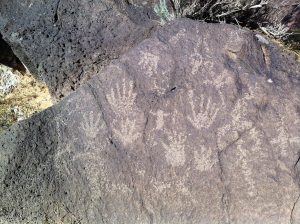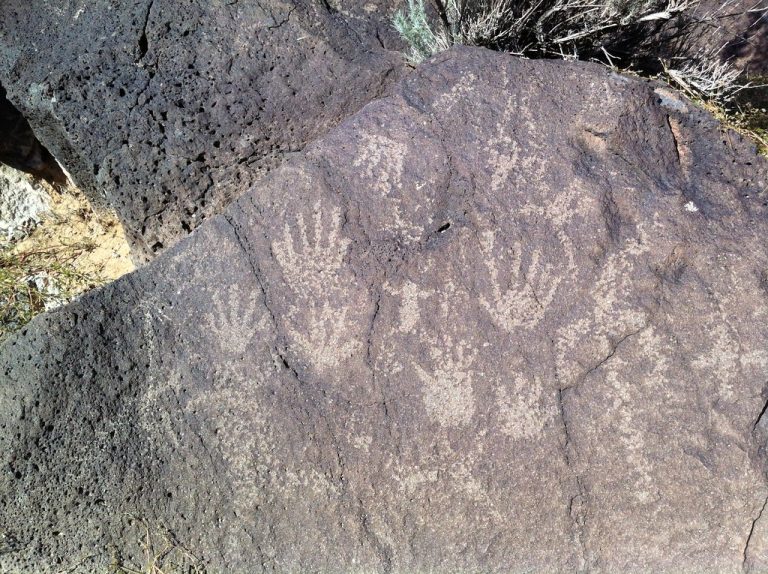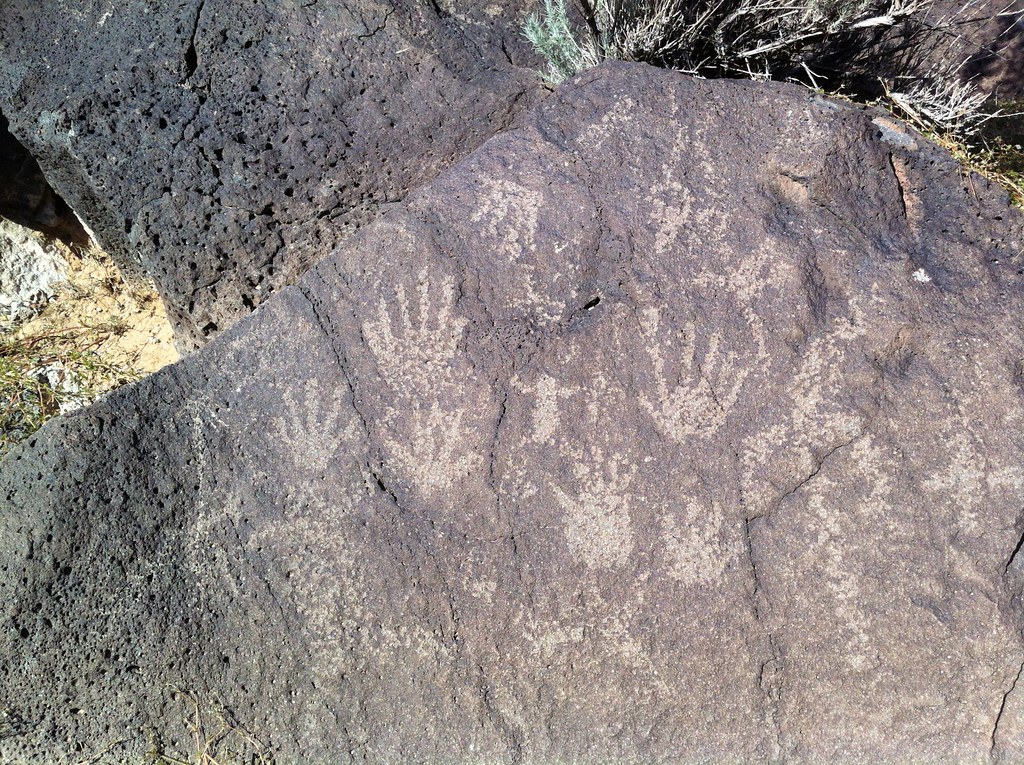
On a Tuesday morning in March, the parking lot at Piedras Marcadas Canyon held exactly three cars. The wind was coming in off the West Mesa, the kind that makes your eyes water, and the basalt boulders along the trail were throwing long shadows across the sand. Within the first quarter mile, there were images everywhere — hands, birds, faces with goggle eyes, spirals, masked figures — pecked into dark volcanic rock by people who lived here hundreds and sometimes thousands of years ago. It’s a lot to take in, and the solitude makes it stranger and more affecting than you’d expect from a trail inside city limits.
Piedras Marcadas is one of three main trail units at Petroglyph National Monument, and it’s consistently the least visited of them. Boca Negra gets the tour buses. Rinconada gets the families doing a quick loop. Piedras Marcadas gets the people who looked at the map carefully and drove northwest through a neighborhood in Corrales and Alameda until the road ended at a small gravel pullout on Paseo del Norte, near Unser. It is not especially well signed. That is part of why it stays quiet.
The canyon itself runs about two miles out and back, with a rougher three-mile option if you want to push farther north. The terrain is flat to gently rolling, nothing technical. But the density of imagery is remarkable — somewhere around 5,000 individual petroglyphs in this stretch alone, the highest concentration in the monument. You’ll cover maybe a hundred yards and then stop, because there’s another cluster of figures on a boulder just off the path. Then another. The images are not roped off or behind glass. You walk past them close enough to see the individual peck marks.
The monument asks that you stay on the designated trail and don’t touch the rock surfaces — oils from skin accelerate deterioration, and these carvings are genuinely irreplaceable. Respect that. Otherwise, the experience is remarkably unmediated: no audio tour, no interpretive kiosks every fifty feet, just the images and the mesa and the Sandias in the distance.
Admission is free at Piedras Marcadas. There’s no fee station, no visitor center at this unit — just a small trailhead with a register and a pit toilet. Bring water regardless of the season; the mesa gets hot and dry fast once the sun is up. The best light for photography is early morning, when the low angle catches the relief of the carved surfaces. Late afternoon works too, but the wind typically picks up by then.
Dogs are allowed on leash, which is worth knowing since the other units don’t permit them on trails. It’s become something of a regular walking spot for people in the adjacent neighborhoods, which gives it an oddly domestic feel — you might pass someone on a morning walk with their lab while also standing next to a 700-year-old image of a parrot.
If there’s a reason to pick this unit over the others, it’s scale and quiet in combination. Rinconada is beautiful, but on weekends it fills up. Boca Negra has better facilities and easier access but costs $2 per vehicle and draws crowds. Piedras Marcadas asks a little more navigation and gives back a lot more space. For anyone who wants to actually sit with what they’re looking at rather than shuffle past it, that trade is worth making.