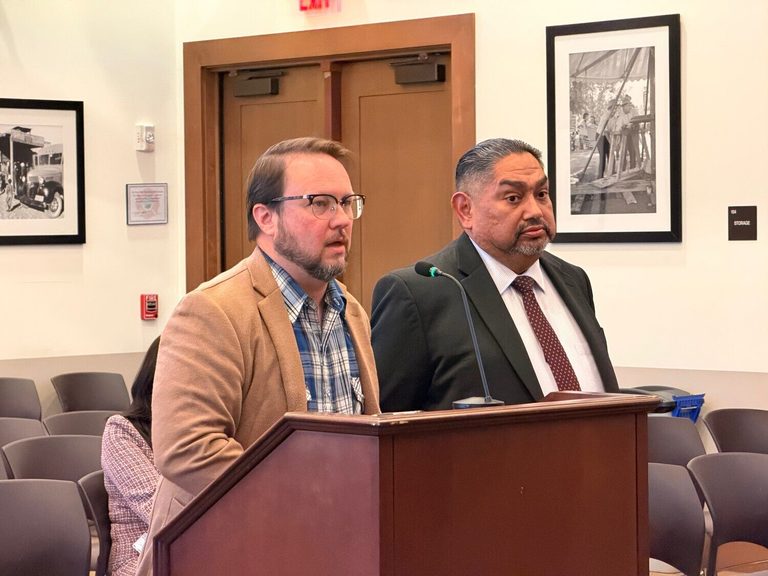
Taos County commissioners met on Tuesday, Nov. 10, to discuss two major initiatives that could shape the county’s future. The first is a draft ordinance that would place an 18‑month pre‑emptive pause on new data‑center projects while the county’s planning staff write clear regulations. The second set of proposals would create a Community Housing Fund to help finance affordable‑housing loans and grants.
Data‑center moratorium
Commissioner An‑Janette Brush likened the rush to build data centers to a gold‑rush, warning that the industry could have “significant impacts on land, water, temperature, noise.” She argued the county currently has no protections for such impacts, and a temporary halt would give officials time to develop safeguards.
Vice Chair Darlene Vigil, presiding in the absence of Chair Miguel Romero Jr., cautioned that the draft’s language urging staff to write rules “immediately” might sideline resident concerns about broader land‑use policy. County contract attorney Patrick Trujillo countered that the moratorium would actually free staff to work thoughtfully, saying, “If anything, I think it frees us up.”
Both Vigil and Brush raised worries about nondisclosure agreements that have been used in data‑center deals elsewhere, noting that some communities have been kept in the dark about such projects. The draft ordinance would limit the use of those agreements, aiming for greater transparency.
No vote was taken on the moratorium. Planning Director Rachel Romero said staff hope to bring the ordinance back for adoption on Dec. 15.
Economic‑mobility study funded by Gates Foundation
The commission also approved a unanimous $81,500 spend of a Gates Foundation grant for a University of New Mexico Bureau of Business and Economic Research study on economic mobility. The study will use seven focus groups and a countywide survey, with a final report and action plan due in June.
Jennifer Ammann, the county’s economic‑mobility and opportunity officer, explained that the project includes a “community co‑design process” to involve residents directly. United for ALICE director Jeanette Brahl presented local data: in 2024, 28 % of the county’s 15,549 households were “asset‑limited, income‑constrained, employed,” and another 19 % lived in poverty, for a combined 47 % of households facing financial strain—higher than the state average of 42 %.
Community Housing Fund proposals
Daniel Werwath, representing Taos Housing Partnership, presented two draft ordinances by video. The first would establish a Community Housing Fund, essentially an affordable‑housing trust. The fund would award loans and grants through a request‑for‑proposals process, requiring recipients to match every $1 of fund money with at least $3 from other sources. Funding would come from short‑term‑rental license fees and proceeds from county land sales, though the fund could be created before any money is on hand.
The second ordinance would raise the income ceiling for county housing assistance from 80 % to 150 % of area median income and shorten the required affordability period for county‑built or repaired housing from 10‑25 years to 5‑20 years.
Vigil praised the concept but questioned the Planning Department’s capacity to manage the fund and objected to letting the department appoint the selection committee. She said, “Boards that are made up, they have to look like the community. I don’t want them to be the gatekeepers of who builds and who doesn’t build.” She also called the Dec. 15 timeline “a very bold request” and suggested a “work study” so commissioners could learn from each other rather than meet one‑on‑one with consultants.
County Manager Brent Jaramillo described the proposal process, but Vigil interrupted, asking specifically about who would sit on the award committee. Jaramillo said the committee would likely consist of county staff, possibly including himself, with the final decision resting with the commission.
Brush added that the fund would give the county a central place to gather housing money from any source, even a future tax on high‑value real‑estate sales. “Any tool to address probably our most pressing crisis in this county is something I’m definitely interested in,” she said.
Other commission actions
Finance Director Emily Rowlinson‑Elliott reported that gross receipts tax revenue was $61,677.58 lower in the first quarter of the fiscal year than a year earlier, attributing the dip to a poor ski season among other factors. Commissioners approved $459,341 for a new ambulance, $292,423 in lodger’s‑tax grants to 21 organizations, and a $1.67 million state grant to replace the Lower Hondo Bridge with an $83,474 county match. They also appointed Commissioner Mascareñas as an ex‑officio member of the Taos MainStreet board.
The NCRTD electric‑bus ribbon‑cutting event is scheduled for Thursday, Nov. 12, from 2 p.m. to 4 p.m. at KTAOS.
Original reporting: Taos News — read the source article.