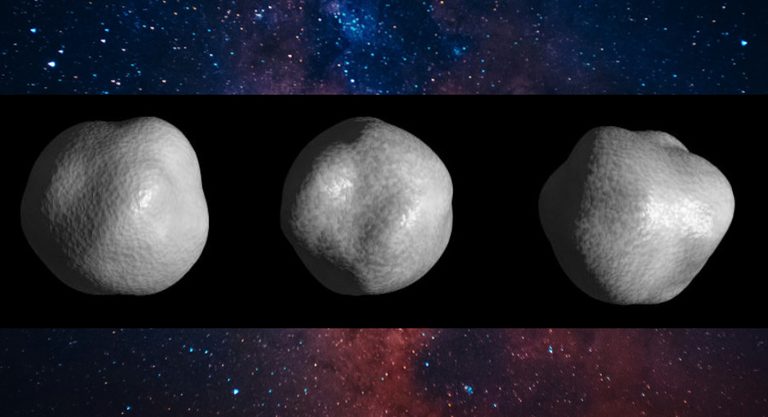
Scientists have eliminated a leading hypothesis for the puzzling motion of a small, fast‑spinning space rock known as 1998 KY26. The 36‑foot‑wide object, which measures about 11 meters across, has been observed accelerating in a direction perpendicular to its orbital plane – a non‑gravitational push that standard asteroid dynamics cannot explain.
Georgia Tech researchers challenge the dark‑comet idea
In a paper published in the peer‑review journal Icarus, Georgia Institute of Technology engineers Korbin Hansen and Masatoshi Hirabayashi modeled the temperature profile of 1998 KY26. Their calculations show that even the coldest regions of the rock remain far too warm to preserve water ice over billions of years. Without ice, the object cannot generate the invisible gas jets that the “dark comet” theory requires.
The dark‑comet concept posits that some asteroids look like ordinary rocks but secretly release invisible gases, acting like tiny thrusters that alter their trajectories. By demonstrating that 1998 KY26 cannot retain the necessary ice, the study effectively removes this explanation from consideration.
What could be causing the acceleration?
With the dark‑comet scenario set aside, scientists are turning to other mechanisms that can produce a sideways push. Solar radiation pressure – the direct force of sunlight on the rock’s surface – is one candidate. Another is the Yarkovsky effect, a subtle force that arises when an object’s surface heats up in sunlight and re‑radiates energy as heat, creating a small thrust.
Because 1998 KY26 spins rapidly, completing a full rotation every 5.35 minutes, dust shedding from its surface is also a plausible contributor. Some researchers even entertain the possibility of an as‑yet‑unknown physical process at work.
Future mission promises close‑up data
Japan’s Hayabusa2 spacecraft, currently on an extended mission, is slated to rendezvous with 1998 KY26 in July 2031. The flyby will provide the first close‑up images and in‑situ measurements of the fast‑spinning rock, offering a chance to test the remaining theories directly.
The mystery surrounding 1998 KY26 echoes earlier questions raised by the interstellar object 3I/ATLAS, discovered in July 2025. Like KY26, 3I/ATLAS displayed unexplained non‑gravitational acceleration after its perihelion passage, though no evidence of artificial propulsion was found.
For now, the exact force nudging 1998 KY26 off its expected path remains an open question, but the new research narrows the field and sets the stage for a definitive answer when Hayabusa2 arrives.
Original reporting: Tampa Free Press — read the source article.