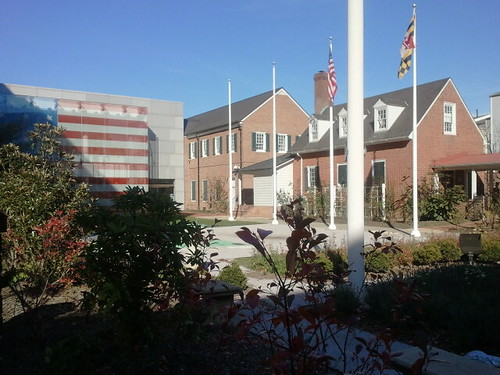
There is a small brick rowhouse tucked into the Jonestown neighborhood of East Baltimore that stopped me in my tracks the first time I walked past it. It sits quietly on East Pratt Street, flanked by the kinds of streets that have seen two centuries of American life roll by, and yet the moment you step through its door, you understand immediately that this is not a quiet place at all. This is where the flag was made.
The Star-Spangled Banner Flag House is the restored 1793 home of Mary Pickersgill, the master flagmaker who sewed the enormous 30-by-42-foot garrison flag that flew over Fort McHenry during the British bombardment of Baltimore in September 1814. That flag, of course, inspired Francis Scott Key to write the poem that became the national anthem. Most people know the song. Far fewer know the woman behind the flag, and that is precisely what makes this place so compelling.
Walking through the house itself feels genuinely intimate. The rooms are carefully preserved and furnished to reflect the period when Mary lived and worked here with her daughter, her nieces, and a team of other women. The sheer scale of the project they undertook is staggering — that flag was so large it had to be spread across a nearby brewery floor to be assembled. The museum does a wonderful job of translating that physical reality into something you can feel, not just read on a placard.
The adjacent Great Flag Gallery is where the experience really opens up. The space houses a full-scale outline of the original flag on the floor so you can walk its dimensions and feel, viscerally, just how massive the thing was. Paired with exhibits on Mary Pickersgill’s life, the War of 1812, and the broader story of women’s labor in early America, the gallery manages to be both educational and emotionally resonant without ever feeling like a lecture.
What I appreciate most about this museum is its perspective. It centers a woman’s contribution to one of the most iconic moments in American history at a time when women’s work was almost entirely uncredited. Mary Pickersgill ran her own business, supported her family, and produced something that quite literally shaped the national identity. The Flag House tells that story with clarity and genuine warmth.
The museum is located at 844 East Pratt Street, just a short walk from the Inner Harbor, making it an easy addition to any downtown Baltimore day. Admission is affordable, the staff is knowledgeable and welcoming, and the whole visit runs a very satisfying ninety minutes or so. Come on a weekday morning if you want the rooms mostly to yourself — there is something especially moving about standing in Mary’s parlor when it is just you and two centuries of history keeping each other company.
Baltimore is full of places where American stories were made. This one deserves far more attention than it gets.