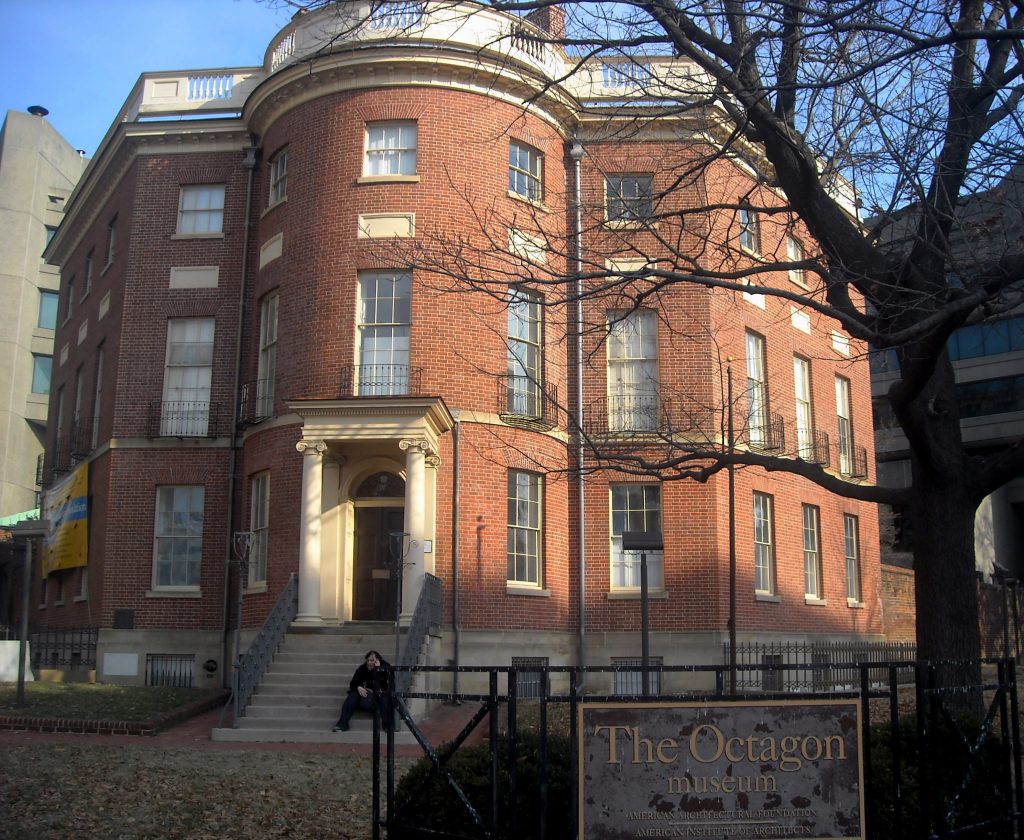
Washington, D.C. has no shortage of storied addresses, but tucked just a few blocks from the White House on New York Avenue in Foggy Bottom stands a house that quietly holds some of the most dramatic chapters in American history. The Octagon House — and yes, despite the name, it has six sides, not eight — is one of the oldest surviving residential structures in the city, and it is absolutely worth an afternoon of your time.
Built between 1798 and 1800 for Colonel John Tayloe III, a wealthy Virginia planter, the house was designed by William Thornton, the same architect who drew up the original plans for the United States Capitol. That pedigree alone should get your attention. But the Octagon’s real claim to fame came in 1814, when the British burned the White House during the War of 1812. President James Madison and First Lady Dolley Madison needed somewhere to live, and Colonel Tayloe offered them his elegant city home. It was right here, in the circular study on the second floor, that President Madison signed the Treaty of Ghent — the peace agreement that formally ended the war. You can stand in that very room. Let that sink in.
The house is now managed by the American Institute of Architects Foundation, and it operates as a small, intimate museum that rewards curious visitors. The rooms have been carefully restored to reflect the Federal-period style of the early nineteenth century, with period-appropriate furnishings, architectural details, and rotating exhibits that explore the history of American design and the building itself. Unlike some of the city’s massive institutions, this place feels genuinely personal. You are not shuffling through endless galleries — you are moving through a real home where real history unfolded at an intimate scale.
The docents here are enthusiastic and knowledgeable, and they are happy to walk you through the house’s more colorful legends, including persistent ghost stories involving the spirits of Tayloe’s daughters. Whether or not you believe in that sort of thing, the stories add a wonderfully atmospheric layer to the visit.
The Octagon sits right at 1799 New York Avenue NW, walkable from the Farragut West Metro station and conveniently close to several excellent lunch spots in the neighborhood. Admission is modest, the crowds are light even on weekends, and the whole visit can be done comfortably in an hour or two. It pairs beautifully with a stroll through the nearby Ellipse or a visit to the DAR Constitution Hall complex just around the corner.
If you want to understand Washington not just as a symbol but as a living, breathing place with a complicated and endlessly interesting past, start here. The Octagon House is proof that the most rewarding discoveries in this city are sometimes the ones you almost walked right past.