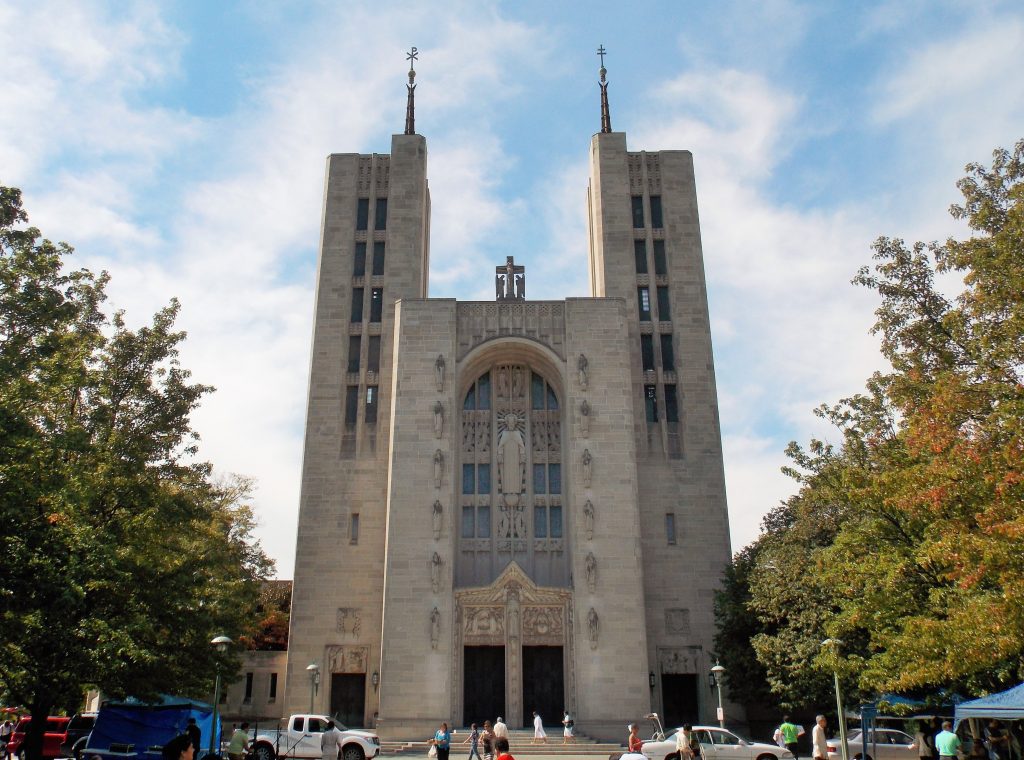
There are places in a city that stop you mid-stride, places where the noise of the street falls away and something quieter and more luminous takes over. The Cathedral of Mary Our Queen, tucked into the leafy Homeland neighborhood in north Baltimore, is exactly that kind of place. I walked through its doors on a Tuesday afternoon expecting a brief look around, and I stayed for nearly two hours.
Completed in 1959 and designed by the architectural firm Maginnis and Walsh, the Cathedral is one of the largest Catholic churches in the United States. But statistics don’t do it justice. What you feel when you step inside is a profound quality of light — warm, shifting, saturated color pouring through 24 monumental stained glass windows that line the nave. Each window tells a chapter of the New Testament, rendered in deep jewel tones of cobalt, amber, emerald, and ruby. On a sunny afternoon, the effect is almost cinematic. The light pools on the stone floor and the marble columns in pools of violet and gold, and the whole interior seems to breathe.
The windows were crafted by the F.X. Zettler studio and feature some of the finest figural stained glass work in the country. Take your time moving down the nave. Don’t rush. Each window rewards a slow, close look — the faces of the figures are expressive and remarkably human, and the layering of color and lead line has a painterly depth you don’t expect from glass.
Beyond the windows, the architecture itself is worth savoring. The Cathedral is built in a blend of Gothic and Romanesque styles, with soaring vaulted ceilings, an elegant rose window above the main entrance, and a sense of proportion that makes the space feel both grand and surprisingly intimate. The marble throughout — floors, altars, and baptistery — was sourced from quarries across Europe and the United States, and the craftsmanship is meticulous.
Getting there is straightforward. The Cathedral sits at 5200 North Charles Street, easily accessible by car with ample free parking, or by the Maryland Transit Administration bus lines that run along Charles Street. Homeland is a beautiful, tree-lined residential neighborhood, and the Cathedral’s grounds themselves are worth a stroll before or after your visit. There is no admission charge, and the Cathedral is open to visitors daily.
If you time your visit for a Sunday morning, you may catch the Cathedral choir, which performs at the solemn high Mass and has a well-earned reputation for musical excellence. Even if you are not there for a service, the acoustics of the space are remarkable — sound moves through it the way light does, gently and completely.
Baltimore is full of architectural ambition, from the Inner Harbor north through its historic neighborhoods. The Cathedral of Mary Our Queen represents the city at its most quietly magnificent. It asks nothing of you except a willingness to slow down and look carefully, and what it gives back in return is genuinely memorable.