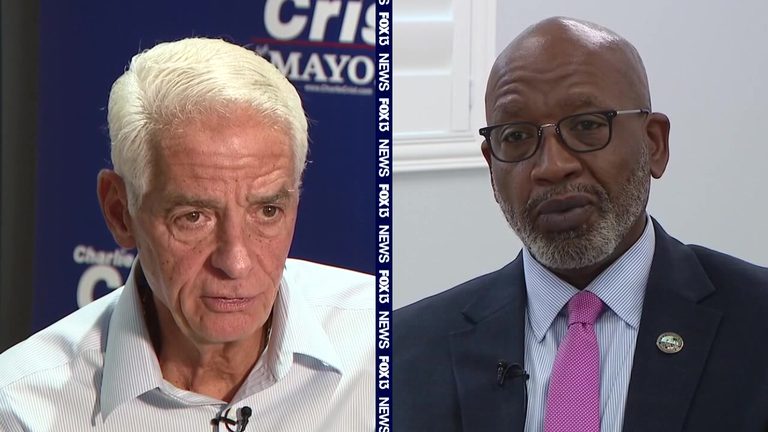
St. Petersburg, Fla. – Residents tuned in Tuesday evening to watch the city’s two mayoral runoff candidates discuss the issues that will shape the upcoming election. Incumbent Mayor Ken Welch and former Florida Governor Charlie Crist debated at 7 p.m. in a one‑hour televised forum, each laying out their vision for the city’s finances, public safety technology and community services.
Amendment 3 and property‑tax reform
Both candidates addressed Amendment 3, a statewide ballot measure slated for the November ballot that would cut property taxes across Florida. Welch warned that a passage of the amendment could create a $35 million budget shortfall for St. Petersburg in its first year and $50 million in the second year. “When you take into account that all of our property taxes don’t even pay for police and fire, so all of those dollars go to police and the fire,” Welch said. “If you’re going to cut that by $35,000,000, then you’re going to cut potentially police and fire, but other things that folks ask us for every year – arts funding, complete streets, housing, homeless programs, mental health.”
To offset the projected loss, Welch suggested the city would need to explore alternative revenue options, such as a dedicated fire fee.
Crist offered a different approach if Amendment 3 fails. He proposed a modest 0.4 percent reduction in property taxes, acknowledging that the city would still need to trim its budget. “Number one, I would look at what’s happening in the administration currently in St. Petersburg, if I have the honor of winning the office in about 25 days or so,” Crist said. “I think you’ll see fewer staffers at city hall. I think we need to tighten our belt. These are kinds of things that I have done previously as Governor.”
Automated license‑plate readers (ALPRs)
The debate also turned to the city’s use of automated license‑plate readers, known locally as Flock cameras. Welch defended the technology, noting that it tracks license plates, not individuals, and likened the need for safeguards to the training and oversight required for police officers carrying firearms. “It’s not tracking an individual, it’s tracking a license plate, and you know, the decision we’ll have to make as a community is, do we have sufficient guard rails around that, just like when we give an officer a gun, I mean that’s the right to take a life,” he said. “Do we have sufficient training, guardrails, protections around that to allow that to continue to be used? So that’s a conversation we’ll have to have.”
Crist called for a pause on the technology pending a privacy review. “I think what we need to do is have a pause, as I have suggested as it relates to that privacy issue for our citizens, and see and work with law enforcement to make sure that they can ensure us that they’re only going to be used to keep us safe, and they’re not going to be used by some of their employees in an inappropriate fashion,” he argued.
Budget and staffing outlook
Both candidates acknowledged that the city faces fiscal pressures and that staffing levels may need adjustment. Welch emphasized protecting core services such as police, fire and essential community programs, while Crist signaled a willingness to reduce city‑hall staff and tighten the belt if elected.
What’s next for voters
The debate will be replayed on local cable and streamed online for residents who missed the live broadcast. With the runoff election just weeks away, voters will weigh the candidates’ differing approaches to tax policy, public‑safety technology and budget management as they decide who will lead St. Petersburg into the next term.
Original reporting: Tampa Bay Florida News (HLL/CB) — read the source article.