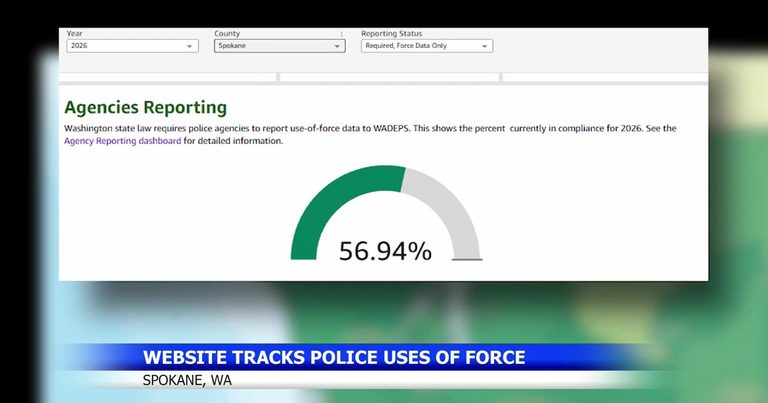
Spokane County residents can now see a snapshot of how often local police and deputies use force, thanks to the Washington Data Exchange for Public Safety (WADEPS) dashboard. The online tool was created under a 2021 state law to increase transparency and build trust between law‑enforcement agencies and the communities they serve.
Statewide reporting versus Spokane County participation
WADEPS identified 301 law‑enforcement agencies across Washington with either general or limited authority. Of those, 211 agencies are required to submit both use‑of‑force incidents and calls‑for‑service data. An additional 40 agencies, such as the Spokane Valley Police Department, operate under contract with another agency and therefore do not report independently. Twenty‑nine tribal agencies have the option to report but are not mandated to do so, while fourteen agencies are either non‑operational or strictly administrative. Seven agencies lack computer‑aided dispatch systems and can only track reportable uses of force.
Statewide, more than 77% of agencies are feeding data into the dashboard. In Spokane County, that figure drops to roughly 57%, indicating a significant reporting gap that local leaders are eager to close.
Local agencies and current reporting status
The dashboard lists ten Spokane‑based agencies. Two—Medical Lake Police Department and Spokane Valley Police Department—show no data because they are contracted through the Spokane County Sheriff’s Office. The Cheney Police Department is the only agency that, according to the site, has not reported any information at all. Cheney officials say their chief is actively addressing the issue and expect the data to appear later this week.
Why the data matters
Transparency in use‑of‑force reporting is a cornerstone of community‑first policing. By making incident numbers publicly available, the state hopes to give citizens a clearer picture of law‑enforcement activity and to foster accountability. The dashboard also pairs use‑of‑force data with calls‑for‑service statistics, allowing analysts to assess whether force is being applied proportionally to the volume of calls.
Local response and next steps
Spokane County officials have acknowledged the reporting shortfall and are working with the sheriff’s office and municipal police chiefs to standardize data submission. “We are committed to full compliance with the 2021 law and to providing our residents with the information they deserve,” a county spokesperson said. The sheriff’s office plans to offer technical assistance to agencies lacking the necessary dispatch systems.
Community groups have welcomed the dashboard as a step toward greater openness, though some advocates urge faster completion of reporting across all agencies. “When the public can see the numbers, it builds confidence and helps us address any concerns proactively,” said a local neighborhood association leader.
Looking ahead
As more agencies upload their data, the WADEPS dashboard will become a more comprehensive tool for tracking law‑enforcement practices statewide. For Spokane County residents, the push to reach 100% reporting is a clear signal that transparency remains a priority for both local officials and the state government.
Original reporting: KHQ Spokane (news) — read the source article.