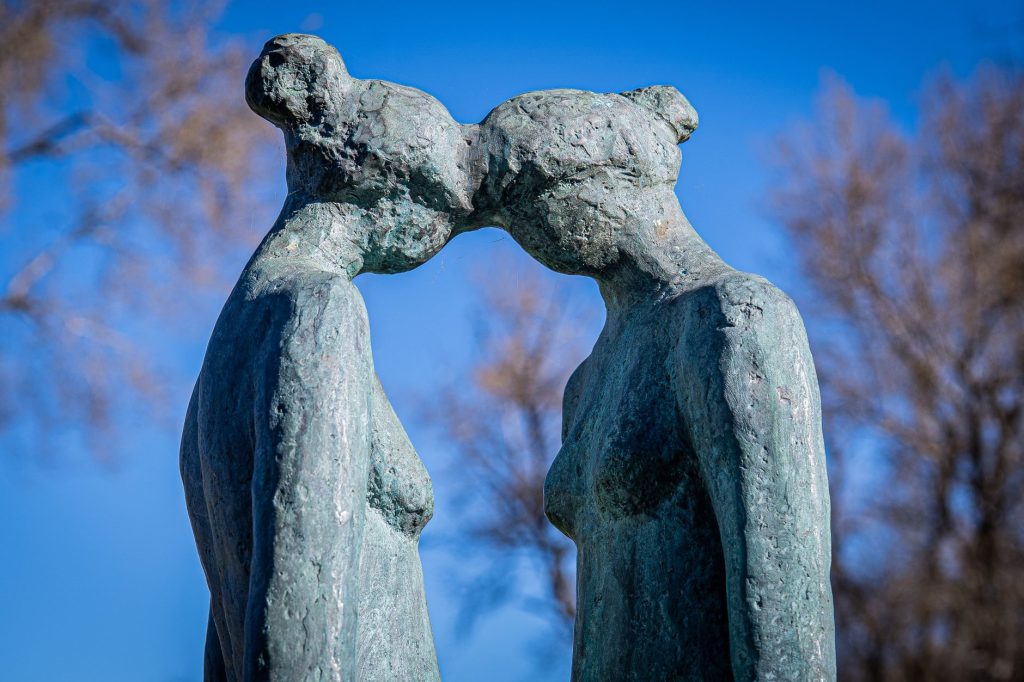
Around four o’clock on a Tuesday in October, the light goes flat and gold across the Delaware Avenue lawn, and there’s a good chance you’ll have the whole place nearly to yourself. That’s when you notice the Rodin sitting there like it’s been waiting for you specifically.
The sculpture grounds surrounding the Buffalo AKG Art Museum’s original Delaware Avenue building don’t get talked about the way the indoor galleries do, which is a shame, because on a decent afternoon they’re one of the more quietly satisfying outdoor spaces in the city. The lawn stretches across a tidy Olmsted-influenced setting — no accident, since Frederick Law Olmsted’s Delaware Park wraps directly around it — and scattered throughout are works that would stop you cold in a museum lobby but somehow feel even stranger and more alive outdoors.
The collection changes periodically, but on any given visit you’re likely to encounter pieces from Auguste Rodin, Henry Moore, and Alexander Calder, among others. There’s something genuinely odd about rounding a corner on a walk you’ve taken a dozen times and finding a large-scale abstract bronze that you can walk around, touch if you feel like being that person, and stare at from whatever angle you want without anyone hovering near you with a laminated badge.
Access is free. That’s worth saying plainly. The museum building itself requires admission, but the grounds are open to anyone willing to walk across the lawn. Families use them, dog walkers drift through, and occasionally you’ll find a college student doing homework on a bench while ignoring a Calder fifteen feet away. The sculptures don’t mind.
The surrounding neighborhood — Elmwood Village bleeds into this stretch of Delaware, and the park’s northern edge connects to the larger Delaware Park loop — means you can build an easy afternoon around it. Walk from Bidwell Parkway, loop through the sculpture grounds, then head east into the park proper or south toward Elmwood Avenue for coffee. It’s the kind of itinerary that feels more thought-out than it actually is.
Spring and fall are the obvious windows. Summer works fine, but the lawn gets busy with general park traffic and the light isn’t as interesting. Winter, honestly, has its own case to make: a few of the larger pieces look genuinely dramatic against snow, and the lack of foot traffic gives the whole thing a slightly surreal quality, like you’ve wandered into a museum after closing time.
The main building is at 1285 Elmwood Avenue, right where it meets Nottingham Terrace. Street parking on the surrounding blocks is usually manageable outside of event weekends. If you’re already paying to go into the museum, budget an extra half hour afterward to walk the grounds with fresh eyes — the shift from interior galleries to open air tends to reset your perception of everything you just saw.
It won’t take more than forty-five minutes to do the full loop, unless you’re the type who stands in front of a Henry Moore for longer than is strictly necessary. No judgment. Some of us are.