There is a particular kind of quiet that only exists in the deepest parts of Florida’s wetlands — a hush punctuated by the slow wingbeat of a great blue heron or the distant, prehistoric bellow of an alligator announcing itself to no one in particular. You can find that quiet, that particular brand of wild Florida stillness, less than thirty minutes from downtown West Palm Beach at the Arthur R. Marshall Loxahatchee National Wildlife Refuge. And once you go, I promise you will keep going back.
The refuge sits at the northern tip of the Everglades ecosystem, spanning nearly 145,000 acres of freshwater marsh, cypress swamp, and wet prairie. It is managed by the U.S. Fish and Wildlife Service and serves as critical habitat for some of Florida’s most iconic and imperiled species — including the endangered snail kite and the elusive Florida panther. But you do not need to be a die-hard birder or a wildlife biologist to fall in love with this place. You just need a pair of comfortable shoes, a decent pair of binoculars, and a willingness to slow down.
The main entrance on Lee Road in Boynton Beach — just south of West Palm Beach — leads you to the Marsh Trail, a well-maintained impoundment levee loop that is genuinely one of the finest short wildlife walks in all of South Florida. The trail is flat, accessible, and lined on both sides by water so alive with birds that even first-timers find themselves stopping every few feet. Anhingas dry their wings on cypress knees. Purple gallinules — absurdly, gloriously colorful — pick their way across lily pads. Roseate spoonbills sweep the shallows in that side-to-side feeding motion that always looks slightly choreographed. During winter months especially, the refuge teems with migratory waterfowl, and the spectacle is genuinely breathtaking.
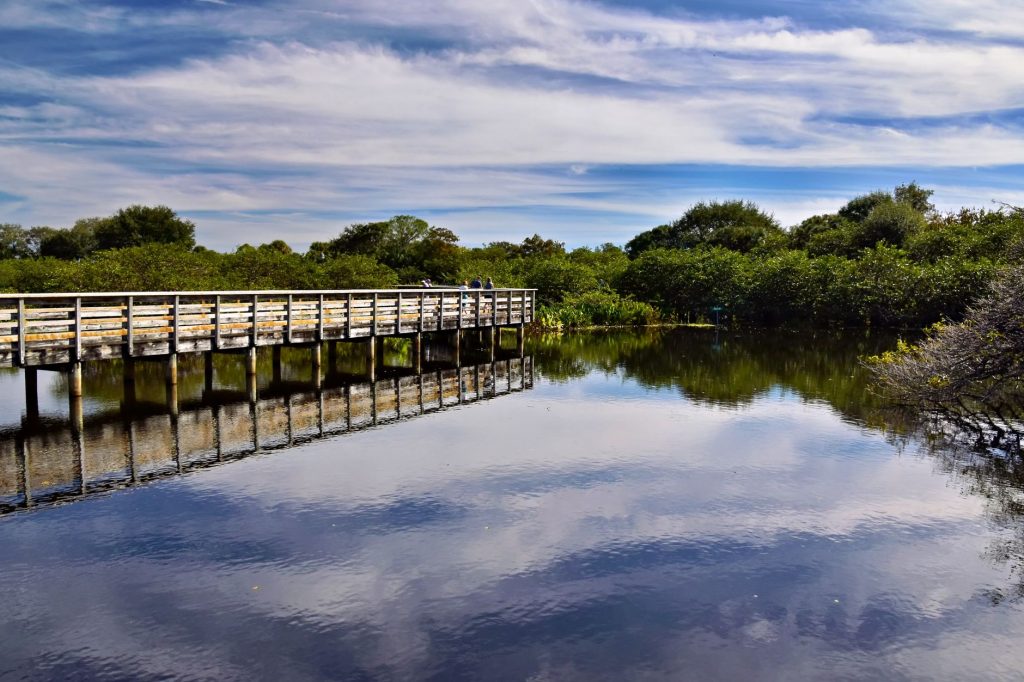
The Cypress Swamp Boardwalk, located near the visitor center, offers a completely different experience — shaded, intimate, and cathedral-quiet beneath a canopy of ancient pond cypress draped in Spanish moss. Walking it on a cool January morning, with shafts of light filtering down through the canopy, is about as close to a meditative experience as Florida gets without a yoga mat involved.
Kayakers and canoeists can launch from the refuge boat ramp and paddle into the interior marsh, where the landscape opens up into something that genuinely feels untouched. Bring your own boat or rent one nearby — a few outfitters in the area cater specifically to refuge paddlers. Fishing is also permitted in designated areas, and largemouth bass anglers know this place well.
Admission is modest — just a few dollars per vehicle — and the visitor center staff are knowledgeable and enthusiastic. Stop in before you hit the trails and ask what has been spotted recently. They will point you in exactly the right direction.
What makes the Arthur R. Marshall Refuge feel genuinely special is not any single dramatic moment, though those happen too. It is the accumulation of small, unhurried encounters with the natural world — a baby alligator sunning itself six inches from the trail edge, a king rail slipping ghost-like through the reeds, a sudden explosion of white ibis rising from the marsh in a loose, wheeling cloud. These are the moments that remind you how extraordinary ordinary Florida can be when given the space to simply be itself.
Pack a picnic, charge your camera, and give yourself a full morning or afternoon. The refuge rewards patience far more than it rewards rushing. Go once, and you will understand immediately why generations of South Floridians have quietly claimed this place as their own.