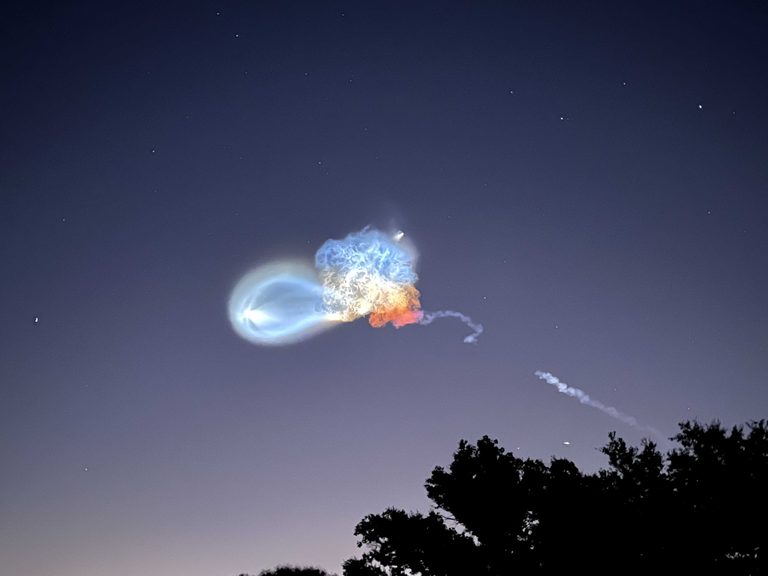
Early Tuesday morning, a SpaceX Falcon 9 rocket roared off the launch pad at Cape Canaveral Space Force Station, delivering the company’s 35th commercial resupply mission to the International Space Station. The lift‑off, timed for 6:33 a.m., coincided with the first light of sunrise, creating a striking visual phenomenon that lit up the Central Florida sky.
What caused the “space jellyfish” effect?
When a rocket launches near sunrise or sunset, sunlight can strike the high‑altitude exhaust plume while the ground below remains in darkness. The illuminated plume spreads out like a glowing, translucent bell, resembling a jellyfish drifting in the night sky. This rare sight, often called a “space jellyfish,” is a natural result of the physics of light and the chemistry of rocket exhaust.
Mission details
The Falcon 9 was carrying a Dragon spacecraft loaded with supplies, scientific equipment, and hardware for the International Space Station. After an approximately 52‑hour journey, the Dragon is expected to autonomously dock with the station on Thursday around 11 a.m. local time, delivering food, clothing, and research payloads that support the crew’s daily operations and ongoing experiments.
Booster recovery plans
Following stage separation, the first‑stage booster began its return flight toward Landing Zone 40, also located at Cape Canaveral Space Force Station. SpaceX aims to land the booster safely on the concrete pad, reusing the hardware for future missions and reducing launch costs—a key part of the company’s sustainability strategy.
Local impact and community response
Residents across Brevard and surrounding counties reported seeing the luminous plume stretch across the horizon, prompting many to share photos and videos on social media. Local businesses near the launch site reported a brief surge in traffic as enthusiasts gathered to watch the event, underscoring the region’s long‑standing connection to the nation’s space endeavors.
Why the launch matters for Central Florida
Cape Canaveral has been a cornerstone of the U.S. space program for decades, and SpaceX’s frequent launches continue to bolster the local economy. The company’s presence supports jobs in aerospace manufacturing, engineering, and tourism, aligning with the region’s tradition of innovation and family‑focused growth. The successful execution of this resupply mission further demonstrates the reliability of commercial partnerships in advancing America’s presence in low‑Earth orbit.
Looking ahead
SpaceX’s next scheduled launch from the same pad is slated for later this month, targeting a satellite‑deployment mission that will expand broadband coverage for rural and underserved communities. As the industry evolves, Central Florida remains a vital hub for both government and private space activities, reinforcing the state’s role in the nation’s scientific and economic future.
Original reporting: WESH Orlando — read the source article.