By: James Matlock
“I’m not sure what part of shall not be infringed people can’t understand. The reason why we have not seen an attack on our soil is because we have the largest unregulated military in the world. Lists give the U.N. and other enemies of our Constitution valuable data.”
That statement cuts to the core of the Second Amendment. The text is not ambiguous: “A well regulated Militia, being necessary to the security of a free State, the right of the people to keep and bear Arms, shall not be infringed.” The operative clause protects an individual right. The Supreme Court affirmed this in District of Columbia v. Heller (2008) and McDonald v. Chicago (2010). “Shall not be infringed” is absolute language. It does not mean “subject to whatever restrictions a legislature or international body finds convenient.”
In the Founding era, “well regulated” meant well-trained, disciplined, and properly equipped—not micromanaged or disarmed by a central authority. George Mason described the militia as “the whole people, except for a few public officials.” James Madison, in Federalist No. 46, highlighted “the advantage of being armed, which the Americans possess over the people of almost every other nation” as a check against overreaching government. The English Bill of Rights of 1689 and the colonial experience of British attempts to seize arms at Lexington and Concord shaped the amendment. Disarmament was a tool of control; the right to arms was a tool of resistance and self-preservation.
The Largest Unregulated Military
Estimates of civilian firearms in the United States range from roughly 393 million (Small Arms Survey, 2017 data) to more than 500 million in more recent industry analyses. Americans own nearly half the world’s civilian guns despite being about 4 percent of the global population. Civilians hold far more firearms than the U.S. military and all U.S. law enforcement combined. Roughly one-third of adults own guns, and defensive uses are estimated in the hundreds of thousands to millions annually.
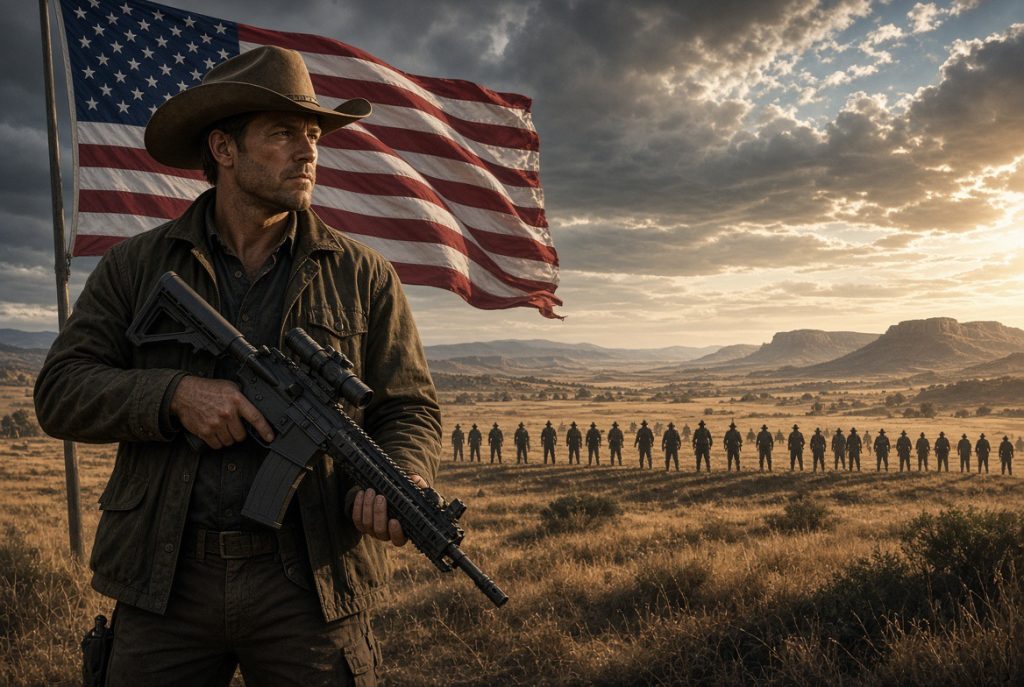
This is not a formal army under federal command. It is decentralized, privately owned, and distributed across households, farms, and communities. That is precisely its strength as a deterrent. An invading force or occupying power does not merely face the U.S. military and its nuclear triad, carrier groups, and global basing. It faces the prospect of sustained irregular resistance by millions of armed citizens who know the terrain, can operate independently, and cannot be easily catalogued or neutralized in a single stroke.
A Russian general, speaking to an American service member about why the Soviet Union never attempted to land forces on U.S. soil, put it plainly: “We were never scared of your army. We were never scared of your military. That’s not what we were scared of at all. Our contingency plans always accounted for your military, but no matter what we did and no matter what we planned, we could not account for the hundreds of millions of people that had firearms in your country. So no matter where we landed the troops, they would be landing under fire. There was nowhere safe for us to go.”
Geography (two oceans, vast interior, limited invasion corridors) and professional military power are primary barriers. The armed populace multiplies the cost of any attempt at control or conquest. No major foreign power has successfully invaded and occupied the continental United States since the War of 1812. The distributed civilian arsenal is a core reason why.
Lists as Intelligence for Enemies of the Constitution
Registration and list-keeping convert private property into government intelligence. Once a government knows who owns what and where, confiscation or selective disarmament becomes a logistical exercise rather than a guessing game. History supplies repeated examples:
- Weimar Germany’s 1928 registration laws supplied the Nazis with lists. After 1933, those records helped disarm Jews and political opponents. The 1938 Nazi weapons law built on that foundation.
- Soviet decrees after 1918 required citizens to turn in firearms under threat of prosecution. Communist regimes across Eastern Europe followed similar patterns.
- In more recent decades, New York City used its long-standing registry to notify owners when certain semi-automatic rifles were banned or reclassified, directing them to surrender, modify, or leave the city. Similar registration schemes in other jurisdictions have met widespread non-compliance precisely because owners understand the endgame.
- UN-supported disarmament programs in parts of East Africa (Kenya, Uganda) under the Programme of Action on Small Arms have involved coercive collection that produced documented abuses, including violence against civilians who refused to surrender arms.
The United Nations has long pursued initiatives on small arms—the Program of Action and the Arms Trade Treaty among them. Proponents frame these as efforts against illicit trafficking. The trajectory is clear: national control lists, reporting requirements, and pressure toward standardized registration. Any comprehensive list of American civilian arms holders is a high-value target for the UN, foreign intelligence services, or domestic actors who view the Second Amendment as an obstacle rather than a feature of the constitutional order. Private transfers outside formal channels remain a practical barrier to a complete national registry; that is one reason they are frequently targeted for restriction.
The Practical Implication
An unregistered civilian arsenal is not anarchy. It is the Founders’ designed backstop for a free state. It deters both external aggression and internal overreach. Lists reverse that logic: they centralize knowledge, lower the cost of confiscation, and hand valuable data to any actor—foreign or domestic—hostile to the constitutional order. The phrase “shall not be infringed” exists because earlier generations understood how easily arms are lost once government keeps the inventory.
Preserving that condition is not nostalgia. It is the practical difference between a people who can still say no and a people who must ask permission.
#2A #secondamendment #constitution #veterans